

.avif)
Key takeaways
• The EU deadline everyone quotes just moved. The Digital Omnibus (agreed 7 May 2026) pushed high-risk AI obligations for surveillance from 2 August 2026 to 2 December 2027. AI video surveillance ethics is now a design problem you have real runway to get right — not a fire drill.
• August 2026 still bites. Transparency duties under Article 50 apply from 2 August 2026, and the public-space biometric bans have been live since February 2025. The clock didn’t stop; it split into stages.
• Alert fatigue, not detection accuracy, is the dominant failure mode. Industry reports on retail loss-prevention put false or irrelevant alerts at 80–95% of the queue. Operators stop looking; real threats slip through.
• Bias is a measurable engineering bug. NIST’s 2025 FRTE data still shows the top face-recognition algorithm producing up to 358× more false positives for the worst-served demographic than the best. Disaggregated test sets are the fix, not an aggregate accuracy headline.
• Building compliance in is 5–10× cheaper than bolting it on. Edge processing, DPIAs, and audit logs cost a fraction up front of what a retrofit costs after a regulator emails you.
Why Fora Soft wrote this AI video surveillance ethics playbook
AI video surveillance ethics stops being abstract the moment a system flags the wrong face, streams a stranger’s biometrics to the wrong region, or drowns a real theft in 200 junk alerts. We’ve been shipping AI-integrated software and video products since 2005 (250+ projects, 50+ in-house specialists, a 99% Upwork success rate), and enough of them touch surveillance that we’ve had to make bias, privacy, and explainability behave like latency: measurable, testable, monitorable.
The proof sits in production. We’re the sole development team behind VALT, a video surveillance and observation platform running across 770+ US organizations with 50,000+ users under HIPAA, plus NetCam for cloud camera streaming. Alongside that: Sprii (Europe’s live-shopping leader, €365M+ in sales) and BrainCert (a WebRTC LMS at 500M+ classroom minutes). Different products, same discipline: a missed detection or a privacy slip becomes a customer-facing incident in minutes.
Our bias is simple: ethics is engineering. Teams that ship trustworthy AI surveillance treat fairness and privacy as properties of the system, not a values statement in the footer. What follows is the framework we run on real product teams under EU AI Act, GDPR, HIPAA, and BIPA pressure — updated for the rules that actually apply in late 2026.
Building AI surveillance and unsure which 2026 rules bind you?
The deadlines just changed. We’ll map your jurisdictional surface and a compliant architecture in a 30-minute call.
Why trustworthy AI video surveillance matters in 2026
Trustworthy AI video surveillance matters because the technology moved from passive recording to active decision-making, and every wrong decision now has a name attached: a shopper misflagged, a worker surveilled without notice, a face matched against the wrong identity. The upside is real: AI safety tools have cut recordable industrial incidents in some deployments by double digits. But the risk surface grew with it. Three forces tighten that risk this year.
1. Regulation, in stages. The EU AI Act’s public-space biometric prohibitions have applied since 2 February 2025. Article 50 transparency duties land 2 August 2026. High-risk obligations for stand-alone surveillance systems (the heavy lift of risk management, logging, and human oversight) were pushed to 2 December 2027 by the Digital Omnibus. Three dates, three different sets of homework.
2. Bias, measured in public. NIST’s Face Recognition Technology Evaluation keeps publishing the same uncomfortable result: false-positive rates that vary by orders of magnitude across demographic groups. The gap is a property of the model and its training data, and it shows up in an audit whether or not you looked for it.
3. Operational reality. Deployed retail loss-prevention systems commonly report 80–95% of alerts as false or irrelevant. Operators tune them out. Real threats drown in noise. Correct, fair, explainable, and operable is now the only kind of AI surveillance worth paying for — and a custom computer-vision build is often the only way to get all four.
One number frames the shift: Cisco’s 2026 Data and Privacy Benchmark found 90% of organizations expanding their privacy programs specifically because of AI adoption. Privacy stopped being a cost center and became a way to win enterprise deals.
The 2026 EU AI Act compliance clock, after the Digital Omnibus
When does the EU AI Act actually bind an AI surveillance product? In stages, not on one doomsday date. The prohibitions are already live, transparency duties arrive in August 2026, and the big high-risk obligations were deferred to December 2027. Here is the sequence we plan every roadmap around.

Figure 1. The EU AI Act arrives in stages. The Digital Omnibus moved high-risk surveillance obligations to December 2027, but prohibitions and transparency duties are already on the clock.
Already in force (since 2 Feb 2025): the prohibited practices. Real-time remote biometric identification in public spaces (with narrow, court-authorised law-enforcement carve-outs), untargeted scraping of facial images, and emotion recognition in workplaces and schools are off the table. Breach this tier and the fine ceiling is €35M or 7% of global turnover.
2 August 2026: Article 50 transparency. If your system infers emotion or biometric categories, the people subject to it have to be told. AI-generated or manipulated content needs disclosure. This date survived the Omnibus untouched, so it is the nearest real deadline for most surveillance products.
2 December 2027: high-risk obligations for stand-alone (Annex III) systems — risk management, data governance, logging, human oversight, and conformity assessment. High-risk AI baked into regulated products (Annex I) gets until 2 August 2028. The extra runway is a gift only if you use it to architect these in rather than promise them later.
Reach for the December 2027 runway when: you sell into the EU and your system is high-risk. Don’t relax — use the 16 extra months to build the audit trail, the DPIA, and the human-in-the-loop controls before they’re mandatory, while your competitors scramble in 2027.
Which 2026 rules actually apply to AI surveillance
Most teams discover the regulatory surface only when procurement asks for a DPIA or a regulator sends a notice. Here’s the snapshot we use as the baseline for every project — note the two EU AI Act penalty tiers, which are routinely confused.
| Framework | Where it applies | Key date | What it requires |
|---|---|---|---|
| EU AI Act — prohibited | EU + EU-facing systems | In force 2 Feb 2025 | No public-space live biometric ID; fine up to €35M / 7% |
| EU AI Act — transparency | EU + EU-facing systems | Applies 2 Aug 2026 | Notice for emotion/biometric inference; fine up to €15M / 3% |
| EU AI Act — high-risk | Annex III surveillance systems | Deferred to 2 Dec 2027 | Risk mgmt, logging, human oversight, data governance |
| GDPR | EU residents’ data | In force since 2018 | DPIA for biometrics, lawful basis, right to explanation |
| ISO/IEC 42001 | Voluntary global standard | Published Dec 2023 | AI management system; layers on ISO 27001 |
| Illinois BIPA | Illinois residents’ biometrics | In force | Written consent; $1K–$5K per violation; private suits |
| HIPAA | US healthcare PHI | In force | Video = PHI in care settings; no cloud transit without a BAA |
Don’t read this as a menu. A US retailer with EU operations needs GDPR + all three EU AI Act tiers + CCPA + (probably) BIPA at once. The compliance surface compounds, and the two fine ceilings are not interchangeable: the €35M / 7% tier is for prohibited practices, while breaching high-risk or transparency duties tops out at €15M / 3%. The full text lives in Article 99.
The three pillars of trustworthy AI surveillance
Trustworthy AI surveillance rests on three load-bearing pillars: data quality, ethical architecture, and compliance instrumentation. Knock any one out and the system fails — usually quietly, through a 90% false-positive rate, a regulator’s notice, or a class action.
Pillar 1: Data quality
Garbage in, garbage out — and in surveillance the input is messy by definition: low light, motion blur, occlusions, extreme angles, compression artifacts. Production systems routinely hit 10× the false-positive rate of the demo, because the demo ran on a clean test set. Three moves fix it: collect demographically balanced training data, preprocess at the edge (denoising, super-resolution, illumination correction), and monitor stream quality continuously — on the live video, not just the model output.
Pillar 2: Ethical architecture
Privacy-by-design is an architecture choice, not a slogan. Edge inference plus face and plate blurring before transmission turns the cloud-side store from a regulatory liability into a metadata index. Federated learning lets multi-site clients train shared models without moving raw video. Differential privacy in training (epsilon 1–5) gives a mathematical guarantee that no individual’s footage was memorised. Explainability tooling (SHAP, LIME, counterfactuals) graduates from research to requirement once high-risk obligations bind.
Pillar 3: Compliance instrumentation
Compliance is mostly logging, retention policy, and DPIA documentation. The EU AI Act, GDPR, ISO/IEC 42001, NIST AI RMF, BIPA, CCPA, and HIPAA share one kernel: prove you minimised data, prove you tested for bias, prove you can explain a decision, and prove a human is on the loop for high-stakes calls. Build that telemetry from day one, or pay 5–10× later in a retrofit.
Reach for all three pillars when: your system processes video in any public, retail, healthcare, financial, or industrial setting. There is no “low-risk” AI surveillance under EU AI Act language — assume high-risk and architect accordingly.
The 2026 AI surveillance tech stack
A modern, ethically-architected AI surveillance product, the engine behind any serious AI video analytics deployment, has four layers. Each carries a build-vs-buy decision and a privacy implication, and the order matters: pixels get cleaned and anonymised at the bottom before anything travels up.
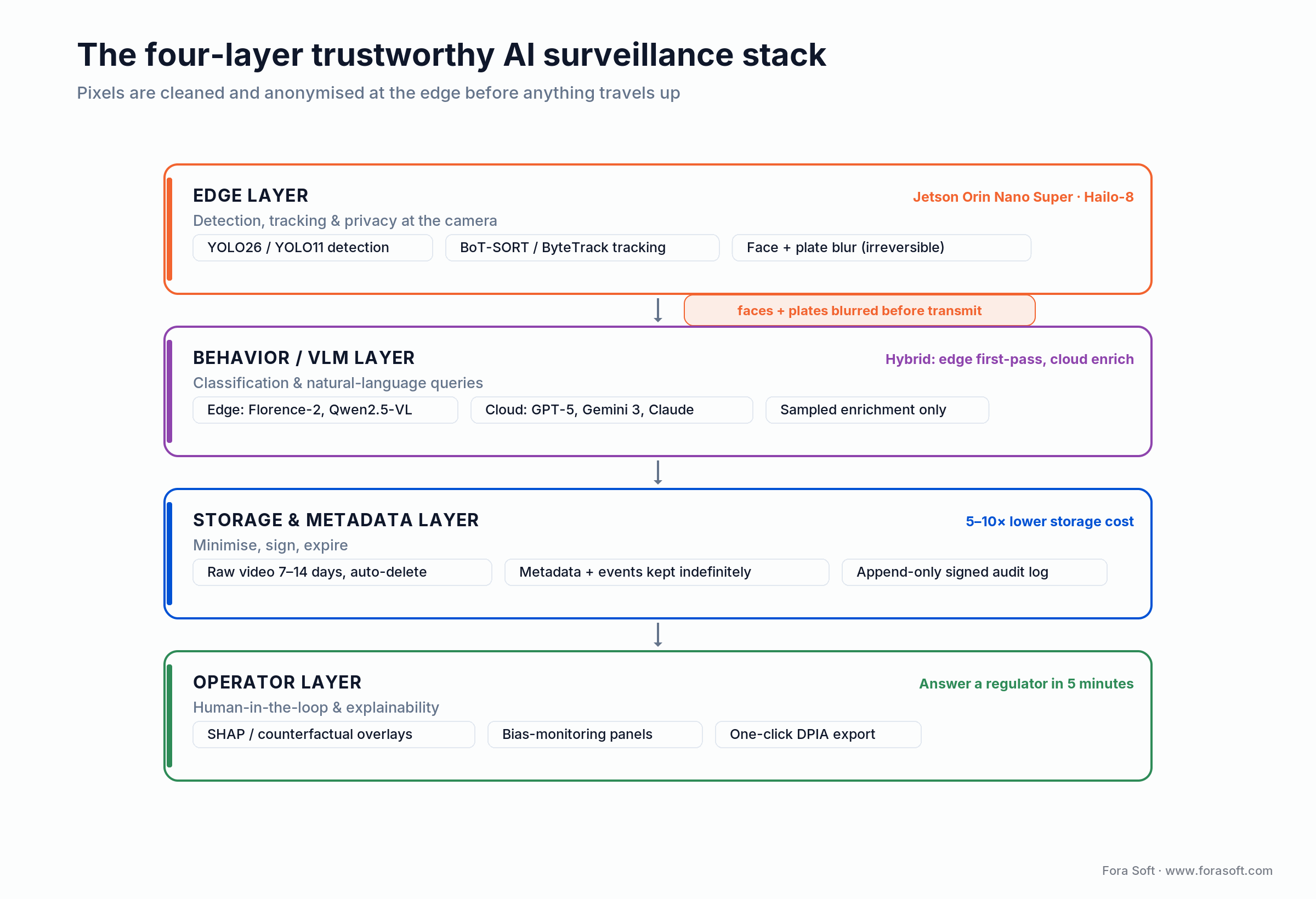
Figure 2. The four-layer stack. Privacy primitives live at the edge, so faces and plates are blurred before a frame ever reaches the cloud.
1. Edge layer. The NVIDIA Jetson Orin Nano Super (67 TOPS, ≈$249, ~7–25 W) is the current workhorse for serious deployments, roughly 1.7× the compute of the older 40-TOPS kit at half the price. Hailo-8 (26 TOPS, ~2.5 W) or the entry Hailo-8L (13 TOPS) suit battery-powered or thermally-constrained cameras. This layer runs object detection (YOLO26, released January 2026 with a native NMS-free head, or the mature YOLO11), multi-object tracking (BoT-SORT, ByteTrack), and the privacy primitives before any pixels leave the box.
2. Behavior / VLM layer. Vision-language models handle behaviour classification and natural-language queries (“show me everyone who entered after 18:00”). Cloud frontier models such as GPT-5-class, Gemini 3 (which leads current video-understanding benchmarks), and Claude Opus give the best accuracy; Florence-2 and Qwen2.5-VL run small enough for on-device. Cloud VLMs are 10–30% more accurate but raise privacy and cost concerns, so the hybrid pattern wins: edge for first-pass, cloud for enrichment on a sampled subset.
3. Storage and metadata layer. Raw video retention 7–14 days at most. Metadata (events, bounding boxes, confidence scores, decisions) indefinitely, in append-only logs with cryptographic signing. Data minimisation isn’t only compliance; it cuts cloud-storage cost 5–10×.
4. Operator layer. Human-in-the-loop dashboards with explainability overlays, bias-monitoring panels, and one-click DPIA exports. This is where compliance becomes operable. If your team can’t answer a regulator’s question in five minutes from this layer, the architecture is wrong. Our deeper build notes live in the video AI agents guide.
Reach for an edge-first hybrid when: you process biometrics, operate in the EU, UK, Illinois or California, or your latency budget is under 200 ms. Cloud-only is a regulatory and operational liability for surveillance.
Not sure your edge-vs-cloud split holds up under GDPR?
We’ll review your architecture and flag the biometric-transit risks before a regulator does. Bring your diagram to a 30-minute call.
Bias and accuracy: an engineering problem with engineering answers
Bias in AI surveillance isn’t a debate; it’s a measurement. NIST’s Face Recognition Technology Evaluation (FRTE, the program formerly called FRVT) keeps publishing the same finding: false-positive rates diverge by orders of magnitude across demographic groups. As of March 2025, the top-ranked algorithm produced roughly 358× more false positives for West African women over 65 than for Eastern European men aged 35–50. Across the top ten systems, West Africans averaged about 23× the false-positive rate of Eastern Europeans. Algorithms submitted in July 2025 still show the demographic hierarchy first documented in 2018.

Figure 3. NIST FRTE 2025. The same top algorithm swings from about 1 false match in 15,000 for the best-served group to about 1 in 50 for the worst — a 358× gap the aggregate accuracy number hides.
The fix is procedural and verifiable, and it doesn’t require solving fairness in the abstract.
1. Demographically balanced training data. Stratify across age, gender, skin tone, body type, lighting, and viewing angle. Document the breakdown in a model card. The cost is real but small next to a class action.
2. Disaggregated test sets. One aggregate accuracy number hides everything that matters. Report precision and false-positive rate per demographic stratum, and gate releases on the worst-cohort number, never the average.
3. Continuous bias monitoring. Production data drifts; demographics drift. Run automated weekly bias audits on live output and trigger retraining when the worst-cohort error rate crosses a fixed threshold — we use 1.5× the best-cohort rate as the trip wire.
4. Test the VLMs separately. Recent research shows vision-language models describe identical footage differently depending on perceived demographic cues — the same loitering read as “suspicious” for one person and “waiting for a friend” for another. If a VLM sits in your pipeline, evaluate it for language-level bias, not just the detector underneath it.
Reach for disaggregated bias testing when: any detector operates on people, vehicles, or a class where misidentification has consequences. Aggregate accuracy is the marketing number; disaggregated is the truth. The full NIST reports are at pages.nist.gov/frvt.
Privacy-by-design patterns that actually work
Edge blurring before transmission. Detect faces and plates at the edge, blur them irreversibly, then transmit. Adds 5–10 ms per frame on a Jetson and drops re-identification risk to near zero.
Selective transmission. Send metadata (event type, bounding box, timestamp, confidence) by default; raw clips only when a named operator requests them with a logged reason. Cuts bandwidth 70–90% and shrinks the breach surface.
Data minimisation with hard retention. Raw video 7–14 days, then auto-delete. Metadata 90 days for operations; longer only with a documented purpose.
Federated learning for multi-site clients. Train on-site, share gradients rather than video to a central aggregator. GDPR-friendly because raw data never leaves the premises.
Differential privacy in training. Epsilon between 1 and 5 gives strong guarantees that no individual’s footage was memorised. Cost: 2–3% accuracy loss at epsilon 5, which is manageable.
Append-only audit logs. Every data access, model decision, and operator override gets a signed entry, retained 3–7 years. Auditors love it; so do engineering teams, right after the first regulator visit.
Reach for federated learning when: you run multi-site deployments under GDPR where moving raw video off-site is prohibited or impractical. Slower training is worth the regulatory cleanliness.
Cost model: what compliant AI surveillance actually costs
A worked example: a 200-camera deployment for a regional retailer, edge-first hybrid architecture, full DPIA, ISO/IEC 42001 alignment, and a human-in-the-loop dashboard. Round numbers, current hardware.
| Line item | Detail | Range |
|---|---|---|
| Edge hardware | Jetson Orin Nano Super or shared node per few cameras | $250–1,500 / camera one-time |
| Edge ops (power, network) | Per camera per month | $30–150 / month |
| Cloud enrichment | Sampled VLM calls, per camera per hour | $0.01–0.05 / cam / hr |
| Storage (metadata + 14d video) | Per 200-camera site / month | $500–2,000 / month |
| Compliance overhead | DPIA, bias audit, ISO 42001 prep | $15K–70K / year |
| Custom build (200 cams, 9–18 mo) | Production-grade with compliance baked in | ≈ $500K–1.5M total |
Walk one line through: at 200 cameras and $100/camera/month for edge ops, that’s $20,000/month, or $240,000/year, before storage and compliance. Add $12,000/year storage and $40,000/year compliance overhead and the run-rate lands near $292,000/year — a number worth seeing before you sign, not after.
The mistake we see most often is funding hardware and ML but deferring compliance instrumentation to “phase 2.” Phase 2 arrives the morning a regulator emails, and by then it costs 5–10× what it would have in the first build. Our estimates run tighter than typical agency timelines because we reuse a compliance-instrumented base, not because we cut the DPIA.
A decision framework: pick your AI surveillance approach in five questions
Five questions decide most of the architecture. Answer them in order; each one narrows the next.
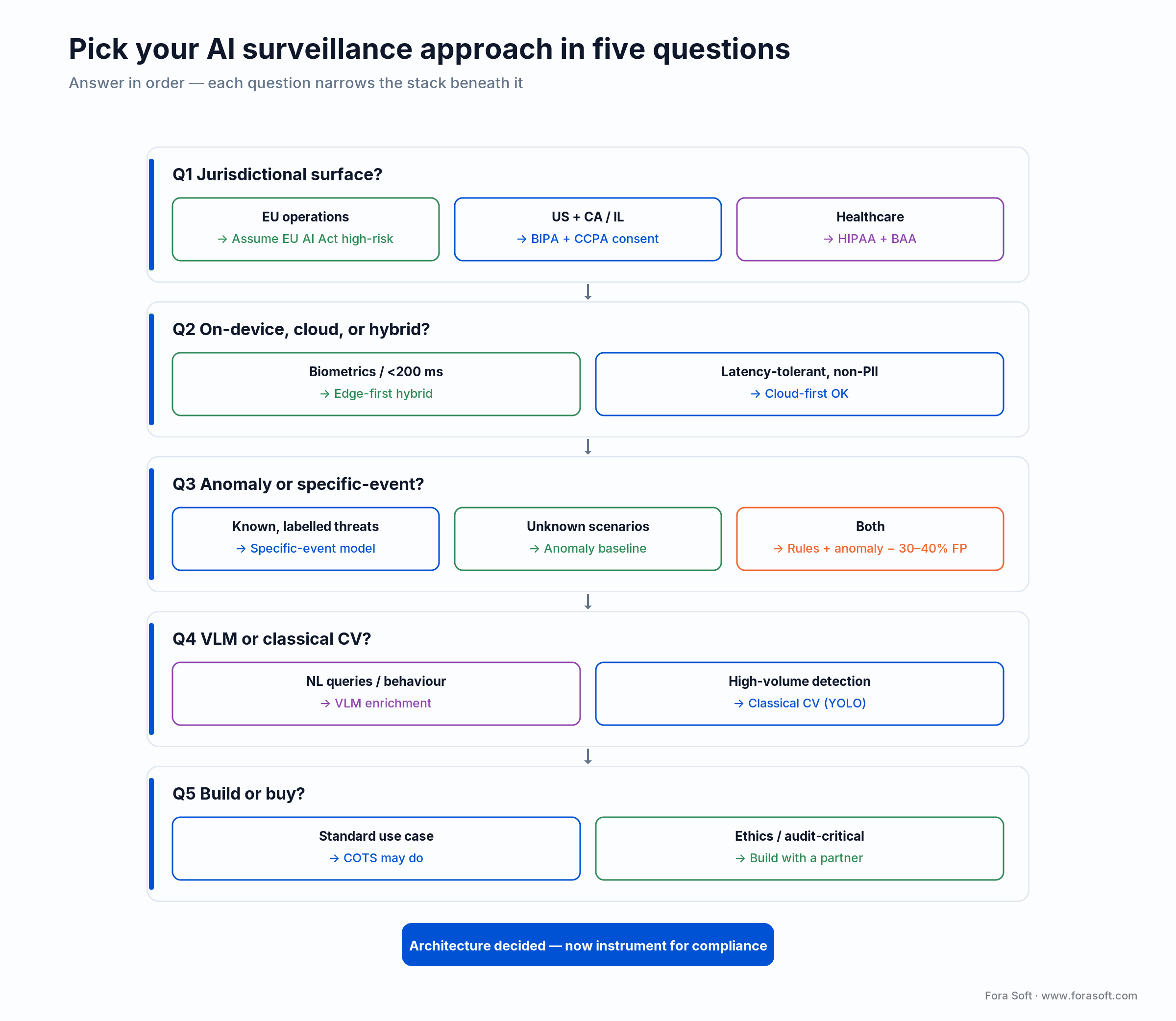
Figure 4. Five questions, in order. Jurisdiction drives architecture, not just paperwork — each answer narrows the stack beneath it.
Q1. What’s your jurisdictional surface? EU operations: assume EU AI Act high-risk. US with California or Illinois: BIPA plus CCPA. Healthcare: HIPAA. Each one drives architecture, not just documentation.
Q2. On-device, cloud, or hybrid? Biometrics or sub-200 ms latency: edge-first hybrid. Latency-tolerant and non-PII: cloud-first is acceptable. The 2026 default is hybrid.
Q3. Anomaly detection or specific-event detection? Known threats with labelled examples: specific-event. Unknown scenarios: anomaly detection on a normal-behaviour baseline. A hybrid of rules plus anomaly baseline cuts false positives 30–40%. Our anomaly-detection models guide goes deeper.
Q4. VLM or classical CV pipeline? Natural-language queries and behaviour classification: VLM. High-volume, low-cost detection: classical CV (YOLO plus a tracker). Hybrid wins again — classical for the fast first pass, VLM for enrichment.
Q5. Build or buy? Standard use case (perimeter, generic PPE, retail loss prevention): a COTS product may do. Custom context, ethics-sensitive deployment, or a bespoke audit trail: build with a partner. Need value in six months: buy first, build later. High compliance risk: build, so you own the audit trail.
Stuck between build and buy for your surveillance product?
We’ve shipped both custom builds and integrations. Thirty minutes and we’ll tell you which one your case actually needs.
Mini case: cutting false-alert volume 7× on a retail surveillance product
Situation. A multi-store retailer ran an off-the-shelf, cloud-only AI surveillance product across 180 cameras. Alert volume was 100–130 per camera per day, and 88% were false positives — glare, occlusion, and shopper density at peak hours. Loss-prevention staff stopped triaging the queue, so real shoplifting slipped through. Compliance was a separate worry: raw video streamed to US-East-1 with no DPIA on file.
12-week plan. We replaced the cloud-only pipeline with a Jetson Orin edge layer (YOLO plus BoT-SORT) doing first-pass detection and tracking, with face and plate blurring before any data left the camera. We added a per-store anomaly baseline trained on 30 days of normal traffic, so the system flagged genuinely unusual behaviour instead of chasing a fixed list of “suspicious” events. The cloud shrank to a metadata index plus occasional clip enrichment with a fine-tuned VLM. DPIA, bias audit, and operator dashboard were built in parallel, not deferred.
Outcome. Alerts fell from 100–130 to 14–18 per camera per day — a 7× cut. False-positive rate dropped from 88% to 39%. Real-incident detection rose 22%, because operators were paying attention again. Cloud egress cost fell 76%. The system was DPIA-clean and on track for ISO/IEC 42001 alignment. Want a similar assessment?
Five pitfalls we keep seeing in production AI surveillance
1. Cloud-first architectures with biometrics. Streaming raw video with faces to a non-EU region is a GDPR violation by default. Fix it before launch, not after a notice. Edge inference plus irreversible blurring is the only safe path.
2. Aggregate accuracy hiding cohort gaps. “94% accurate” without per-cohort numbers tells you nothing about which demographics the system fails on. Always test disaggregated.
3. VLM hallucinations in surveillance contexts. Cloud VLMs occasionally fabricate details of footage they didn’t see clearly — clothing colour, behaviour, intent. Add confidence thresholds, sample-review against ground truth, and never let a VLM trigger an enforcement action on its own.
4. Vendor lock-in on proprietary edge boxes. Appliances that accept only their own model format tie you down. Stick to open standards — ONVIF for cameras, ONNX for models — so you can swap silicon without rewriting the system.
5. Cross-camera re-identification leaking PII. If your tracking metadata (gait, clothing, height) lets you re-identify a person across stores, you’re processing biometrics whether you meant to or not. Hash person IDs per location and silo metadata by site.
KPIs to track once the system is live
Quality KPIs. Aggregate precision and recall (target precision above 70% in steady state), worst-cohort precision and recall (target within 1.5× of the best cohort), false-positive rate per camera per day (target under 25), and human-override rate. A healthy override rate sits at 10–30%: less means humans aren’t really reviewing, more means the model is wrong.
Business KPIs. Incident-detection rate versus the prior baseline, mean time to response for real events (target under five minutes), shrink reduction (retail benchmarks land around 5–15%), and operator NPS. If operator NPS is low, the system is generating noise.
Reliability KPIs. Edge uptime per camera (target above 99%), model-drift detection lag (target under seven days from onset to retrain trigger), audit-log integrity (100% append-only, no gaps), and time to produce a DPIA-ready report (target under one hour from request).
When NOT to deploy AI surveillance
Three cases where we tell clients to wait or scale down. Saying so has never lost us a serious client.
Public-space biometric identification in the EU. Real-time remote biometric identification in public is a prohibited practice under the EU AI Act, save narrow court-authorised law-enforcement carve-outs. If the use case is “identify everyone walking past,” you’re in banned territory, not high-risk territory.
Pre-DPIA deployments under GDPR. Skipping the DPIA on biometric processing is a textbook violation. Don’t deploy until it’s complete and signed.
Vendor-locked stacks you can’t audit. If a vendor won’t share model documentation, training-data provenance, or bias evaluations, you can’t prove compliance and you’re carrying their risk on your balance sheet. Pick a vendor who lets you audit, or build it yourself.
How to benchmark an AI surveillance product before launch
Marketing demos lie by curation. Build a held-out evaluation set on real footage from your actual cameras — diverse demographics, lighting, and event types — and score every candidate system on the same set.
Detection accuracy. Aggregate precision and recall, plus disaggregated by cohort. Never accept a vendor’s aggregate-only number.
False-positive rate at operating threshold. Tune for your operational reality. If 25 false positives per camera per day is your ceiling, score the system there, not at its best-case setting.
Adversarial resilience. Test with sunglasses, hats, masks, low light, motion blur, and rain. Production footage is messier than any benchmark dataset, and the system that wins on clean data often loses in the wild. For the streaming layer beneath all this, see our note on video surveillance engineering.
Handling VLM hallucinations safely in surveillance pipelines
Cloud VLMs sometimes describe footage they didn’t see clearly. The model reports “person in a red jacket carrying a backpack” when the person wore blue and carried nothing. In a surveillance context that hallucination becomes evidence in an incident report, so treat VLM output as a suggestion, never a verdict.
Mitigation 1: ground-truth sampling. Review 5% of VLM outputs against the source clip. If agreement falls below 90%, pause the model and re-evaluate.
Mitigation 2: confidence thresholds and abstention. Configure the model to return “cannot determine” instead of guessing when confidence is low. Harder to enforce on cloud APIs, but achievable with structured outputs and strict prompting.
Mitigation 3: never let a VLM trigger enforcement. Behaviour classification feeds the operator dashboard; a human confirms before any action. A VLM that drives an alarm with no human on the loop is a lawsuit waiting to happen.
Questions to ask any AI surveillance vendor before signing
Six questions separate a vendor who has done the work from one who hasn’t. Ask them in writing.
1. What’s your worst-cohort precision and recall on a representative test set — not the aggregate?
2. Can you produce a model card documenting training-data demographics?
3. What’s your data-residency and retention story for EU customers?
4. Are your models exportable to ONNX, or am I locked to your edge appliance?
5. How do you support DPIA production for your customers?
6. Have you completed an ISO/IEC 42001 audit, or are you on a roadmap to one?
FAQ
When does the EU AI Act actually apply to AI surveillance?
In three stages. Prohibited practices (real-time public biometric ID, untargeted face scraping, workplace emotion recognition) have applied since 2 February 2025. Article 50 transparency duties apply from 2 August 2026. High-risk obligations for stand-alone (Annex III) surveillance systems were deferred by the Digital Omnibus from August 2026 to 2 December 2027; product-embedded (Annex I) high-risk gets until 2 August 2028. Fines reach €35M or 7% for prohibited practices and €15M or 3% for high-risk or transparency breaches.
Did the EU AI Act high-risk deadline really move to 2027?
Yes. The Digital Omnibus, agreed in provisional form on 7 May 2026, deferred high-risk obligations for Annex III systems from 2 August 2026 to 2 December 2027. It takes legal effect on formal adoption and publication in the Official Journal. The transparency obligations and the prohibitions were not deferred, so August 2026 and February 2025 both still matter.
Why does cloud-first AI surveillance create privacy risk?
Streaming raw video with faces and plates to the cloud builds a centralised store of biometric data (a special category under GDPR Article 9) and forces cross-border transfers under Article 44 for any non-EU region. Edge inference plus irreversible blurring before transmission cuts the surface to a metadata index, which is far simpler to keep compliant.
What does “edge AI” mean in video surveillance?
Edge AI runs detection and tracking on hardware at or beside the camera, on a module like the NVIDIA Jetson Orin Nano Super (67 TOPS) or a Hailo-8 (26 TOPS), instead of shipping raw video to a server. It cuts latency below 200 ms, and it lets you blur faces and plates before anything leaves the box, which is the difference between a metadata index and a biometric database in the cloud.
How much does a compliant 200-camera AI surveillance product cost to build?
Production-grade systems with edge processing, a full DPIA, bias auditing, ISO/IEC 42001 alignment, and human-in-the-loop dashboards typically run $500K–1.5M for the initial 9–18 month build. Ongoing costs are $30–150 per camera per month for edge ops, plus $15K–70K per year for compliance overhead. A 200-camera site often lands near a $290K/year run-rate.
How do I prove my AI surveillance system isn’t biased?
Three artifacts: a model card documenting training-data demographics, a disaggregated test report showing precision and recall per cohort, and a continuous bias-monitoring dashboard comparing production output across cohorts week over week. Aim to keep the worst-cohort error rate within 1.5× of the best. Anything more uneven is an audit risk you’ll have to explain.
Can VLMs like GPT-5 or Gemini 3 be used in AI surveillance?
Carefully. Cloud vision-language models are 10–30% more accurate on behaviour classification than small on-device models, but they add privacy cost (raw video to cloud), dollar cost, and documented demographic bias. Use the hybrid pattern: edge for first-pass detection, a sampled cloud VLM for enrichment, confidence thresholds, and a human-in-the-loop gate. Never let a VLM trigger enforcement directly.
Do I need ISO/IEC 42001 certification?
Not legally, today. But ISO/IEC 42001 (published December 2023) is fast becoming a procurement requirement in EU and UK enterprise sales, and it’s the cleanest way to demonstrate EU AI Act readiness for high-risk systems. Design for alignment from day one and pursue certification as the deployment matures.
What to read next
Build guide
YOLO + ByteTrack detection-and-tracking pipeline
The technical recipe behind a modern, ethically-architected surveillance detector.
Edge AI
Edge AI vs Cloud AI for video surveillance
Latency and cost numbers behind the architecture choices in this article.
VMS
Video surveillance software: buyer & builder guide
The VMS layer that stores, indexes, and serves everything the AI produces.
Video AI
How video AI agents work in 2026
Architecture, latency, and per-minute economics of agentic video AI.
Anomaly detection
Anomaly detection models for video surveillance
The model choices behind the false-positive cuts described here.
Ready to ship trustworthy AI video surveillance?
The operating reality of late 2026 is straightforward. The EU AI Act arrives in stages (prohibitions live, transparency in August 2026, high-risk pushed to December 2027), and the extra runway rewards teams who build compliance in rather than promise it later. Operators abandon noisy systems. Bias is a measurable property you can gate releases on. Privacy-by-design is an architecture, not a slogan. Compliance is mostly logging and DPIA work done early.
If you want a sanity check on your current surveillance product — or a plan to bring it into EU AI Act and ISO/IEC 42001 alignment before your competitors have to — we’ll do the work with you. Since 2005, 250+ projects, 50+ in-house specialists, a 99% Upwork success rate, and a live surveillance platform across 770+ organizations. Bring your DPIA gap; we’ll bring the architecture.

The book · Volume 7 of 7
AI for Video: A Complete Guide to Intelligence in Video Products: From Real-Time Pipelines and Agents to Serving, Cost, Compliance, and Verticals
Bias testing, edge privacy and the EU AI Act clock are where this playbook ends, and where a compliant surveillance product starts. Volume 7 of our handbook treats regulation as engineering: EU AI Act obligations, biometrics and C2PA provenance, plus the serving setup and cost per stream-hour that decide whether privacy-by-design survives production. Written by Nikolay Sapunov, CEO at Fora Soft.
Read it on Amazon →Kindle & paperback · Fora Soft Video Engineering Handbook
Want a custom, compliant AI surveillance product?
We’ll scope it, price it, and ship it — with the privacy, bias, and compliance instrumentation that keeps you safe under EU AI Act, GDPR, BIPA, and HIPAA.