
Key takeaways
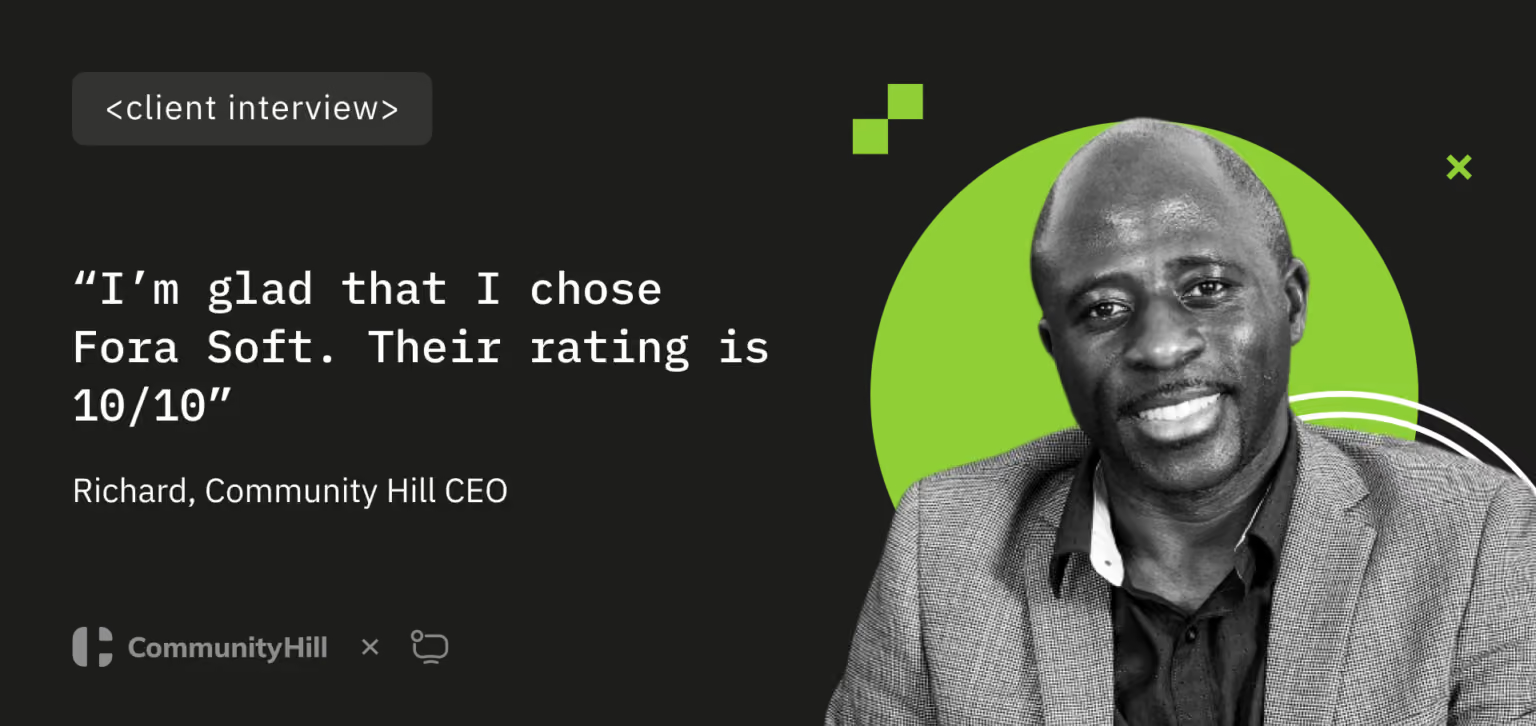
• Ten out of ten, in his words. After a decade chasing the right development partner and a failed attempt with a freelancer, Richard, the founder of Community Hill, rates Fora Soft 10/10 on communication, professionalism and project involvement.
• What moved the needle: a real team, not a single coder. Richard had previously worked with freelancers who disappeared, delivered off-spec, and never mentioned user stories or a development plan. A cross-functional team (PM, developer, designer, QA, analyst) removed the silent-failure risk.
• Communication is the entire job for a non-technical founder. Richard’s single biggest piece of advice to future clients: be available. His project moves because he is in constant contact with the PM and the developer — issues surface fast, decisions get made fast.
• An MVP is a feedback machine, not a shipping target. Community Hill launched as an iOS MVP, has already shaped a Phase 2 scope, and will expand to Android and web once funding lands — the pattern we recommend to every bootstrapped founder.
• This interview is the unvarnished version. We asked Richard directly what he wished we had done better. He could not name anything. We are publishing the transcript exactly as he said it.
Why Fora Soft is sharing this interview
Over 21 years and 250+ products, we have worked with a lot of first-time founders. Almost all of them arrive with the same question: “how do I know this team will actually deliver?” We could write another generic post about hiring a software development company. Instead we are letting Richard — the owner of Community Hill, a local-marketplace iOS app we built together — describe the experience in his own words.
Why Richard? Because his story is not a highlight reel. He spent a decade trying to build the right marketplace product, worked with freelancers who let him down, and told us up front that Fora Soft was his last try. He is the person most founders will relate to. His conclusions about communication, teamwork, and MVP thinking are worth more than any sales deck we could draft.
If you are comparing agencies, freelancers and in-house options for your own custom software build, read the interview below and use the short decision framework we added at the end.
Thinking about finally starting your MVP?
Thirty minutes with a Fora Soft engineer is usually enough to scope an MVP, name a realistic budget, and tell you if you even need us.
Meet Richard: ten years of chasing the right marketplace idea
Richard is the founder of Community Hill, an online platform for local towns and villages. Residents list household items for sale — furniture, vehicles, tools, electronics. Local service providers (electricians, gardeners, handymen) post their services. People message inside the app, agree on price and location, and meet in person to close the deal. It is a hyper-local, trust-driven marketplace — think small-town Craigslist with a modern iOS experience.
The idea is ten years old. Richard first tried to build it “back when Amazon was only selling books” and has been circling it ever since. Multiple attempts with individual freelancers missed the mark. By the time he reached Fora Soft he described us as “my last try” — a sentence we take seriously when we hear it.
What we built together
An iOS MVP covering the core marketplace loop: profile creation and phone/OTP verification, geolocated listings, in-app chat for negotiations, service-provider categories, search, reporting and moderation. The architecture mirrors the patterns we use on other marketplaces like Yard Sale Firm — location-based content, real-time messaging, identity verification, lightweight AI moderation — tuned for small-town trust dynamics.
Why we went out of our way to get the honest version
Nikita (the interviewer) went in trying to draw out the things Richard wished Fora Soft had done differently. Negative feedback is more useful to us and more credible to readers. Richard politely refused to deliver any — not because he was shy, but because he genuinely could not name a gap. We are publishing the transcript exactly as recorded, lightly edited for readability. Make up your own mind.
The interview: Richard, founder of Community Hill
What is Community Hill, and who is it for?
Richard. Thank you for this opportunity. Community Hill is an online platform that brings together people from various communities — mainly the towns and villages where they live. People sell household items, including furniture, vehicles and other goods. Service providers — electricians, for instance — post their services. Anyone interested gets in touch, they agree on a time and location, and they do the transaction in person. That’s what Community Hill is about. We’re building the community together.
How did you find Fora Soft?
Richard. That was last year — around August or September. I went to an online auction platform first. I was looking for a team that could really make a good product. One of the Fora Soft team members contacted me. We got in touch, and I’m glad we got started. I’ve been with you for nine or ten months, and I’m still with you because we have Phase 2 coming up.
Was Fora Soft your first choice?
Richard. No. At first I contacted one of the programmers on that platform. There are so many programmers there — you can never know whether someone really knows what he’s doing or whether he’s also outsourcing somewhere else. The first person didn’t do a good job at all, so I kind of lost hope in individual freelancers. I decided I needed a team that can really build something. When I searched again, Fora Soft showed up — nothing else. I read the reviews and that was it. I didn’t look for anything else.
Did you really need the whole team — PM, designer, QA, marketing?
Richard. I needed all of them. Designing a logo — I’m not an artist and I don’t know what a good logo should look like. I needed everyone on board because I didn’t know how the best user stories should be written either. So I just needed a team of everyone to be on board.
“And then when I was told that we even have testers, I was so glad that they had that team.”
What would you want Fora Soft to improve? Any downsides?
Richard. I haven’t come across anything, because Fora Soft is good at communicating. You keep in touch. I’m always communicating with the programmer, the project manager, the designer. Because of that constant communication there hasn’t been a gap for doubt. Every time I have an issue or an idea, I ask them and we find a solution right away. If we need a call, we book one.
The app is iOS. Are you going to Android or web too?
Richard. Yes, definitely. If we get more funding, I want to finish Phase 2 of iOS and then add the Android version and the web version as well.
Community Hill is an MVP today — who has tested it?
Richard. It’s been me at the moment. I haven’t had a chance to ask family members yet, so it’s me and the programmer for now. If you are new to the idea of launching small, our primer on what an MVP actually is covers the thinking behind this.
How did the team handle bugs you hit during testing?
Richard. At some point, while I was testing the MVP, it crashed. I mentioned it to the programmer and he said he was going to find a solution. Other than that, I didn’t see any bugs on my side. On their side they might have seen more — they have more testers — but for me that was it.
Richard. Yes. He told me they had also identified other issues and were going to work on them. We had a follow-up meeting scheduled for that week. Editorial note: the meeting went well, Fora Soft resolved the issues and the MVP moved into the next sprint.
What is your advice to other Fora Soft clients?
Richard: “Anyone who comes to Fora Soft should really be available for constant communication.”
If you are too busy to keep in touch, it will be hard to keep the project moving. Communication keeps you and the programmers on the same page — your expectations and theirs on the same level. Starting with the analyst, the programmers, and the rest of the team: it’s about communication.
Do you have a technical background? Did you ever feel out of your depth?
Richard. A little bit. I’ve been trying online businesses for about ten years — starting when Amazon was only selling books. I always had the marketplace idea but not the money. I reached out to local programmers back then; they did their best but never built what I wanted. Over the years I picked up enough to understand what a good product should look like, even though I don’t code.
Richard. I didn’t feel I needed to be a developer. I knew what the final product should feel like — I’ve watched Amazon change its interfaces for a decade. I told the team what the experience should be, they handled the code. Fora Soft is my last try. If it fails, I let it go. But I trust this round.
On a scale of ten — communication, professionalism, project involvement?
Richard. Ten out of ten. The local developers and freelancers I worked with before didn’t even tell me about user stories.
“I first heard about user stories from Fora Soft.”
I had never heard the term. The freelancers didn’t know these things — they didn’t have the professional knowledge of how a project should run. They didn’t even give me a development plan. I first saw a development plan from Fora Soft. Those freelancers didn’t do that. I’m glad I chose Fora Soft — ten out of ten.
Looking for the team Richard calls “ten out of ten”?
Tell us about your product idea. We’ll come back with a scope, a team shape, and an honest price range — in writing, within 24 hours.
What founders should take away from this interview
1. A team beats a talented individual. Richard’s pre-Fora-Soft freelancer was probably skilled. That did not matter once the work needed design, testing, project management and a real development plan. If your product is more than a prototype script, the cheapest-looking individual quote almost always becomes the most expensive option by month three.
2. Treat communication like a feature, not a formality. Richard attributes the entire success of the project to constant contact with his PM, developer and designer. If you cannot commit to a standing weekly call and responsive messaging, compensate with a project manager who runs the communication for you — do not skip it.
3. User stories and a written development plan are table stakes. If a vendor cannot show you a written development plan with user stories, milestones and a QA strategy before signing, that is a red flag. We publish the same artefacts at kickoff on every engagement.
4. You do not need to be a developer. Richard has almost no coding background. He knows what the product should feel like and communicates that clearly. A good team translates product intent into implementation — that is the entire value exchange.
5. Ship the MVP, then iterate. Community Hill launched narrow and real, then fed feedback into Phase 2. Trying to build a full Amazon-style marketplace before user one would have burned Richard’s runway. The MVP primer explains the trade-offs.
Freelancer, agency, or in-house: the comparison Richard went through
Richard effectively ran the classic founder experiment on his own: a cheap freelancer, then an agency (us). Below is the shortcut for the next founder reading this. It mirrors what we tell people on discovery calls.
| Option | Best for | Typical budget | Main risk |
|---|---|---|---|
| Individual freelancer | Throwaway prototypes, single-screen demos, tiny tweaks | USD 2–15k for most jobs | Silent failure; no design, QA, PM, or plan |
| Agency / outsourced team | MVPs and production builds with real deadlines | USD 40–250k for an MVP, higher for enterprise | Picking the wrong agency; check reviews and references |
| In-house team | Funded scale-ups owning a long-term core platform | USD 500k+/year fully-loaded per small team | Hiring velocity and burn rate before product-market fit |
| Hybrid (agency + in-house PM) | Funded startups scaling from MVP to v2 | USD 150–400k + 1–2 in-house hires | Division of responsibility; needs a sharp contract |
Rule of thumb: if the project has more than one screen, more than one user type, or you care about it still working in six months, pick a team over a freelancer. The price delta is small; the outcome delta is enormous.
A decision framework — pick your software partner in five questions
Q1. Do they have reviews from comparable clients? Upwork, Clutch, LinkedIn, and published case studies. A vendor with zero public review history is a much bigger risk than a vendor with mixed reviews.
Q2. Will you get a named cross-functional team or one generalist? Richard’s outcome flipped when he moved from one freelancer to a team with PM, developer, designer, and QA. Confirm roles in the proposal, not the sales deck.
Q3. Can they show a written development plan and user stories before you sign? If no, walk away. This is the fastest sanity check there is.
Q4. What is the communication cadence? Daily Slack, weekly demos, fortnightly steering. If the vendor is vague about cadence, you will spend the project chasing them.
Q5. Do they say no to things? A partner who agrees to every idea, every deadline and every last-minute scope change is not protecting your budget — they are selling hours. We push back on bad ideas. So does every vendor worth hiring.
Five pitfalls non-technical founders keep falling into
1. Picking the cheapest bid. The cheapest freelancer is usually the most expensive outcome. Richard is the living proof. Compare three bids; pick the middle one from a team with references.
2. Asking for “the whole thing” at launch. Scope creep kills MVPs. Launch with the single loop that validates the idea (list, match, transact) and iterate from there.
3. Ghosting the team. Project managers cannot compensate for a silent founder. Be reachable or delegate explicitly.
4. Skipping design and QA to save money. Both compound. A bad logo and a buggy onboarding kill conversion on day one; redesign costs 2–3× more than designing it right the first time.
5. Not asking about the post-launch plan. Who owns the code? Who maintains the app? What does a hotfix cost? Sort it in the contract, not after an App Store outage.
Similar stories from other Fora Soft clients
We publish every founder interview — good, average, or critical. A selection that pairs well with Richard’s story:
- Jesse, Vodeo — a movie-renting platform rebuilt for a legacy media catalogue.
- Anthony, Speakk — a mobile messenger that does not consume cellular traffic.
- Jan, AppyBee — a booking platform for small service businesses.
- Naseem, Mobytap — a business video review platform.
- Ali, TapeReal — a video-first social network.
Tired of the wrong freelancers and half-finished prototypes?
We have been the “last try” for dozens of founders. Book a call and we will tell you honestly whether your product idea is ready for a team, or whether it needs a sharper MVP scope first.
What Community Hill looks like under the hood
For readers evaluating the kind of work Fora Soft does on a marketplace MVP, a quick tour of Community Hill’s technical shape:
Identity. Phone-number verification with OTP. Reduces fake accounts — critical on a trust-driven local marketplace. No third-party social login required.
Listings. Geolocated posts with categories for goods and services, lightweight content moderation on upload, configurable radius filter.
In-app chat. Real-time messaging between buyer and seller, with PII-aware warnings when a user tries to share a phone number or address outside the safe flow — the same pattern we use on Yard Sale Firm.
Moderation and safety. Report buttons on every listing and every chat thread, plus an admin panel for manual review. Light AI moderation on free-text fields catches the obvious abuse patterns.
Platform. Native iOS (Swift) for the MVP, a REST backend, Postgres, object storage for images. Android and web are in the Phase 2 roadmap. For the cost shape of a marketplace MVP across platforms, see our mobile app development cost guide.
FAQ
Is this a real interview?
Yes. Nikita from our team spoke with Richard, the owner of Community Hill, on a recorded call. The transcript has been lightly edited for readability but all quotes, ratings and opinions are Richard’s own. We specifically pushed for negative feedback; Richard politely declined to provide any.
How much does a marketplace MVP like Community Hill cost to build?
With Agent Engineering, a single-platform (iOS-only) marketplace MVP with auth, listings, chat and moderation lands in the USD 60–120k range over 10–16 weeks. Cross-platform (iOS + Android + web) roughly doubles. These are conservative ranges; the scoping call establishes a firm estimate. For a deeper view, read our guide to software estimating.
Why did Richard’s first freelancer attempt fail?
Richard’s words: “You can never know whether someone really knows what he’s doing or whether he’s also outsourcing somewhere else.” The freelancer delivered partial work, never produced a development plan, and never explained what user stories were. A solo freelancer is fine for a quick prototype; for anything longer than two months you need a team with PM, designer and QA.
How technical do I need to be to run a project like this?
Not very. Richard has almost no coding background. What he does have is a clear mental model of what a good product should feel like and the discipline to communicate it. A good agency translates intent into code; your job is to articulate the user experience, the business model, and the priorities.
Will Community Hill expand to Android and web?
That is the plan. Phase 2 on iOS is in progress; Android and web follow once funding is in place. Launching on a single platform first keeps the burn rate low and the feedback loop tight.
What should I look for when choosing between a freelancer and an agency?
Team composition (PM + design + dev + QA), a written development plan, public reviews, clear ownership of the codebase after launch, and a realistic communication cadence. Richard lost months to a freelancer who could not produce any of these. The decision framework above walks through the full checklist.
Can I talk to Richard or another Fora Soft client directly?
Yes. We regularly arrange reference calls with past clients for prospects who are far enough along in their evaluation. Ask on the discovery call and we will organise one that matches your domain — marketplaces, video, EdTech, healthcare, and so on.
How do I cut costs on a software project without cutting quality?
Start by cutting scope, not craft. Our piece on what not to cut lists the five places founders sabotage themselves — skipping QA, skipping design, underpaying the PM, etc. Richard’s example makes the point concretely.
What to Read Next
MVP thinking
What is an MVP — and why cut features to launch early
The thinking behind Community Hill’s iOS-first launch: ship the core loop, then iterate.
Estimating
How Fora Soft estimates software projects
The written process we use to turn a product idea into a defensible budget and timeline.
Cost guide
2026 Mobile App Development Costs: What a Real Estimate Looks Like
Specific budget ranges for iOS, Android and cross-platform MVPs, with worked examples.
Cost control
What not to cut to save money on your software project
The five false-economy decisions we see founders regret within the first three months.
Client story
Jesse, Vodeo — rebuilding a movie platform for Janson Media
Another founder interview: different vertical, same lessons about team and communication.
Ready to be the next ten-out-of-ten?
Richard’s story is not unusual. Most of the founders who become long-term Fora Soft clients arrived after at least one disappointing attempt elsewhere. What turned the project around was not more code — it was a real team, a written development plan, user stories, QA, and a founder willing to stay in constant contact with his PM.
If you are at a similar point — good idea, wrong first vendor, running out of patience — the fastest thing we can do is spend 30 minutes with you. We will be honest about whether we are the right fit. If we are not, we will point you to someone who is.
Let’s scope your MVP or your next phase
Thirty minutes, a real engineer, a written plan. No deck. No sales theatre.

