
AI didn’t kill SEO. It split your job into three. You now show up, or you don’t, in Google’s blue links, inside Google’s AI Overviews, and inside the ChatGPT, Perplexity and Claude answers that increasingly settle a question before anyone clicks. Ahrefs measured a 58% drop in click-through on the number-one organic result when an AI Overview sits above it (December 2025). The traffic that still arrives is smaller and more decided: across 94 ecommerce brands in 2025 (Visibility Labs), visitors referred by ChatGPT converted 31% higher than non-branded organic search.
This playbook is the short, honest version of how to use AI SEO tools in 2026: what to buy, what to skip, which workflows actually move pipeline, and where a software company like ours puts humans back in the loop instead of letting the model drive. No affiliate ranking, no “10x your traffic” promises. Just the stack and the moves we run on our own blog.
Key takeaways
• SEO is now SEO + AEO + GEO. You optimise for classic blue links, Google’s AI Overviews (2.5B monthly users by mid-2026), and generative engines like ChatGPT (800M weekly users) — win one, leak the other two.
• Buy one tool per lane. Research (Ahrefs or Semrush), on-page optimisation (Surfer, Clearscope, Frase or NeuronWriter), generation (ChatGPT or Claude). Stacking three research tools just burns budget.
• AI buys hours, not judgement. Hand it research, briefs, drafts, internal linking and technical audits; keep humans on positioning, voice, fact-checking and E-E-A-T.
• Scaled AI content is a penalty, not a strategy. Google’s scaled-content-abuse policy (March 2024) targets mass low-value pages whether written by a human, a model or both. One sourced article beats ten templated ones.
• Getting cited by AI is mechanical. A Princeton study across 10,000 queries found that adding statistics, citing sources and quoting experts lifts AI-answer visibility up to ~40%. Evidence beats adjectives.
Why Fora Soft wrote this playbook
We’re Fora Soft — a software company that has shipped 250+ products since 2005, with about 50 engineers who build AI features for a living. Our video-analytics platform V.A.L.T. runs in 770+ organizations with 50,000+ active users; our AI-in-learning work shows up in Scholarly and InstaClass. We also run our own inbound engine, and we rebuilt it around AI tooling over the last 18 months.
So this is what we actually do — not what a tool vendor’s pricing page promises. The workflows, prices and pitfalls below come from real campaigns, paid subscriptions we still pay for, and the early experiments where a model wrote confident nonsense and we nearly shipped it. We’ll tell you where AI earns its seat and where it quietly costs you rankings.
If you run marketing at a software company, or you founded one and inherited the blog, this should help you decide what to buy, what to ignore, and where to put a human back in charge.
Building an AI product that has to rank and get cited too?
We design SEO-aware, schema-rich architecture into AI apps so your public surface is crawlable and quotable in AI answers from day one.
The one-page answer: how AI SEO works in 2026
AI SEO in 2026 means optimising one page to show up in three places at once: Google’s classic results, Google’s AI Overviews, and generative engines like ChatGPT and Perplexity. Two shifts forced this. First, AI Overviews now sit above organic results on most informational queries and reach 2.5 billion monthly users, citing three to five pages each. Second, ChatGPT hit 800 million weekly users in late 2025 and cites its sources too. Your page has to earn a slot in all three.
The stack that gets you there has five moving parts:
- Research — Ahrefs or Semrush for keywords, competitors and backlinks, plus AI-citation monitoring (Ahrefs Brand Radar, Semrush AI Visibility).
- Briefs & ideation — Frase or MarketMuse for topic clusters, question extraction and entity coverage.
- Draft — ChatGPT or Claude with tight prompts and your own evidence, never “write me an article about X”.
- Optimise — Surfer, Clearscope or NeuronWriter for on-page scoring, schema and entity recall.
- Ship & measure — Search Console and GA4 for clicks and conversions, Brand Radar or Profound for generative citations.
Everything else in this guide is detail on top of that skeleton. Here’s the shape of the three surfaces you’re optimising for.
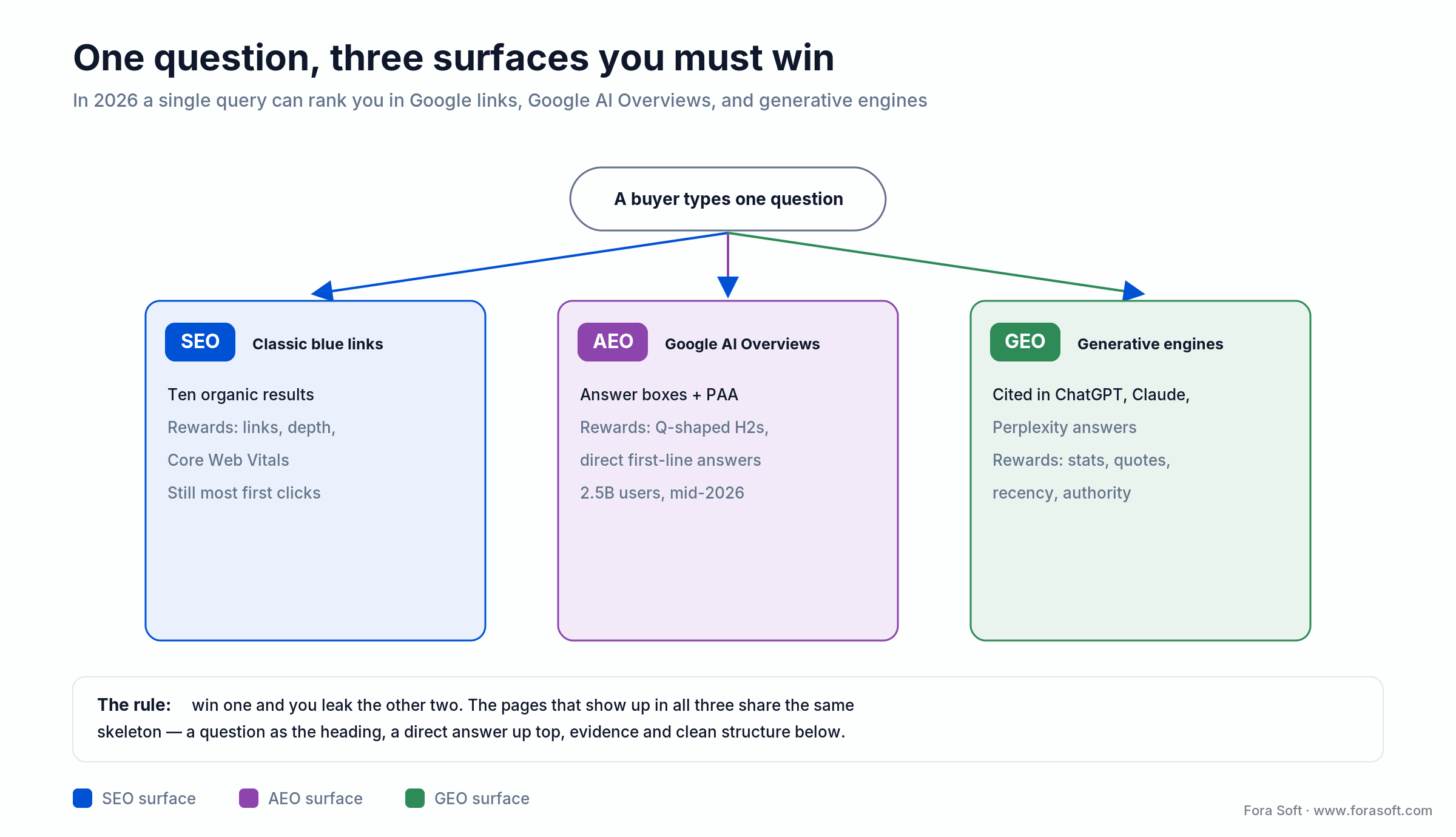
Figure 1. The three surfaces one page must win in 2026, and the shared skeleton that gets it into all three.
Reach for AI SEO tooling when: you’re publishing more than two pieces a month, you’re competing for queries that trigger AI Overviews, or you need to defend organic traffic while the team stays small.
SEO, AEO and GEO — what’s actually different
Three acronyms get thrown around as if they were the same discipline. They’re not. Here’s the practical split.
SEO (classic). Ranking pages in Google’s ten blue links. Still alive, still driving most clicks, still reacting to core updates. Most brand-agnostic buyers still type their problem into a search box before they open a chatbot.
AEO — Answer Engine Optimisation. Getting cited inside Google’s AI Overviews, featured snippets and People Also Ask. The formula is mechanical: an H2 phrased as the exact question, a one-to-three-sentence direct answer at the top of the section, then the depth. Get cited in an AI Overview and Seer Interactive found you pull 35% more organic clicks than when you’re absent.
GEO — Generative Engine Optimisation. Getting quoted by ChatGPT, Claude, Perplexity and Gemini. These engines favour authoritative domains, recent content, explicit sourcing and clean structure. Track your citation rate here as a KPI separate from Google rankings — the two move independently.
The three tool families you actually need
Every AI SEO tool on the market does one of three jobs. Buy one per lane and you have a working stack; buy three that overlap and you’ve just paid three times for keyword volume.
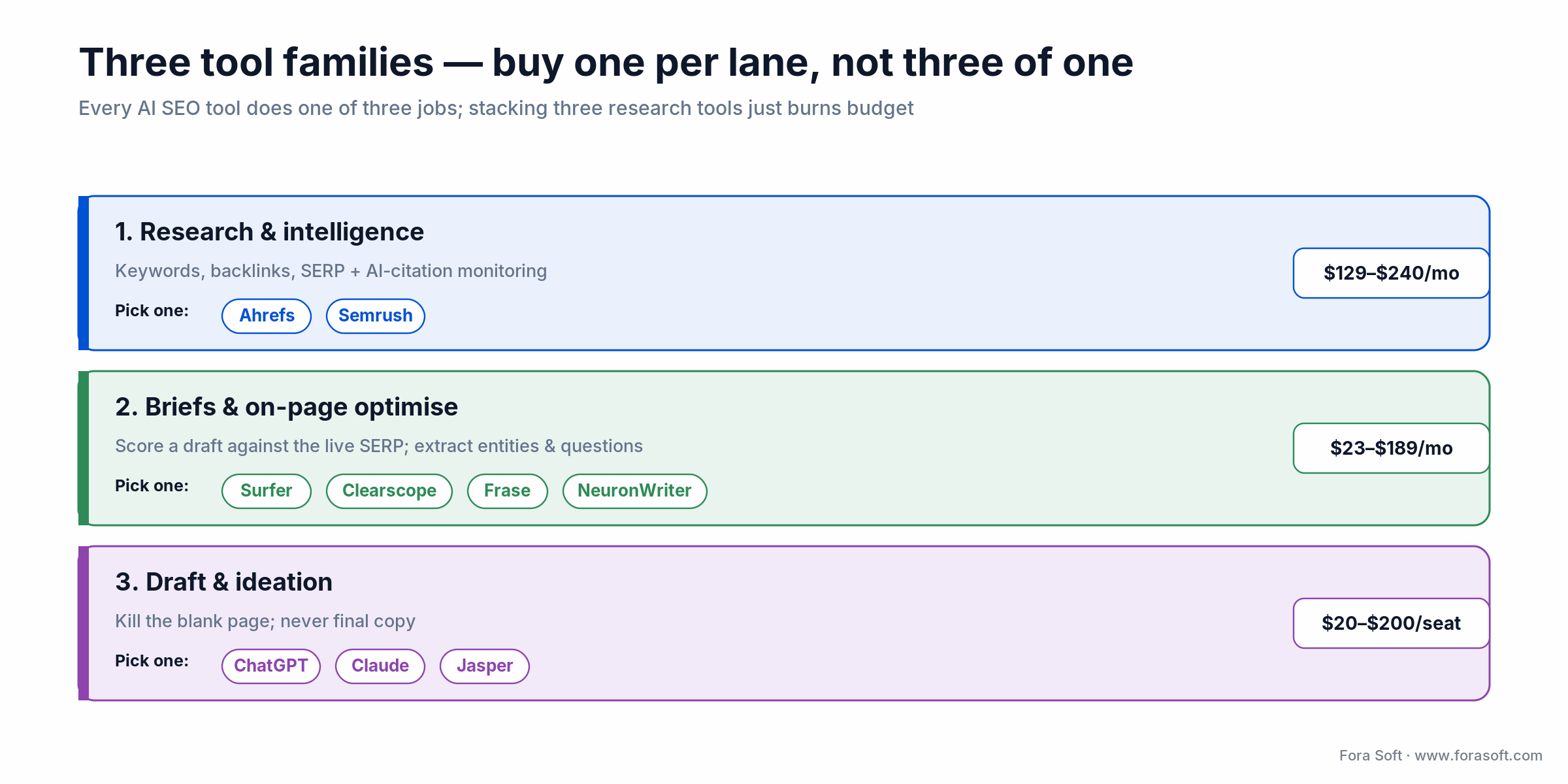
Figure 2. The three tool families and rough price bands — pick one per lane, not three of one.
1. Research & intelligence
Ahrefs (Lite from $129/mo) and Semrush (Pro from $139.95/mo) are the incumbents. Both now bolt on AI layers: Ahrefs’ Brand Radar tracks citations across six AI engines from 243M+ real People-Also-Ask prompts; Semrush ships a separate AI Visibility toolkit that pushes the bill toward $240/mo. Pick one. Ahrefs wins on backlink data; Semrush on the breadth of connected marketing channels.
Reach for a research tool when: you need real keyword volume, backlink gaps and SERP intel, and you want one dashboard that also watches whether AI engines cite you.
2. Briefs & on-page optimisation
Surfer SEO (from ~$99/mo) and Clearscope (enterprise-priced, roughly $170+/mo) are the standards for scoring a draft against the live SERP. Frase ($45–$115/mo) leans into question extraction and AEO-friendly briefs. MarketMuse (from ~$149/mo) is heaviest on topic-authority planning. NeuronWriter ($23–$69/mo) is the budget pick with surprisingly good NLP.
Reach for an optimiser when: you already know what to write and need the entities, questions and structure the top-ranking pages share, so a good draft doesn’t miss the obvious terms.
3. Draft & ideation
ChatGPT (GPT-5-class, $20–$200/seat) and Claude ($20–$200/seat) are the general-purpose drafting engines. Jasper (~$59/mo) wraps them in marketing templates and brand-voice controls. None of them replace an editor; all of them kill the blank page. Treat their output as a first draft that’s confidently wrong about 10% of the time.
Reach for a free or budget stack when: you publish fewer than two articles a month — Google Search Console (free), NeuronWriter ($23/mo) and a ChatGPT or Claude free tier cover most of what you need before you scale up.
AI SEO tools compared
Prices move — treat the table as directional, and expect annual billing to knock 15–25% off. The column that matters most is the last one: where each tool falls short, so you buy the second tool that covers the gap instead of a second tool that does the same job.
| Tool | Family | Approx. price / mo | Best for | Where it falls short |
|---|---|---|---|---|
| Ahrefs | Research | $129–$1,500+ | Backlinks, SERP intel, AI-citation monitoring (Brand Radar) | Not a content optimiser |
| Semrush | Research | $139.95–$500+ | All-in-one; PPC + SEO teams | AI Visibility is a paid add-on |
| Surfer SEO | Optimise | $99–$219 | Live editorial scoring | Thin on strategy and backlinks |
| Clearscope | Optimise | ~$170–$1,000+ | Enterprise editorial teams | Expensive at SMB volume |
| Frase | Optimise | $45–$239 | AEO-oriented briefs & Q&A mining | Smaller backlink graph |
| NeuronWriter | Optimise | $23–$69 | Budget on-page NLP | Fewer integrations, rougher UI |
| ChatGPT / Claude | Draft | $20–$200 / seat | First drafts, outlines, rewrites, schema | Hallucinates without your sources |
| Jasper | Draft | ~$59–$125+ | Brand-voice marketing templates | Needs a research tool beneath it |
The tools reviewed: where each wins and breaks
We pay for most of these, run them on live client campaigns and on this blog, and judge them on Search Console and GA4 results over months, not demo reels. Here’s the honest read on each — what it’s best at, what it costs, and where it breaks.
Research & intelligence
Ahrefs ($129+/mo). A best-in-class backlink index and SERP dataset, now with Brand Radar for AI-citation tracking across six engines. Where it wins: link intelligence and honest keyword difficulty. Where it breaks: it won’t score or draft your content, and agency tiers climb fast past $1,000/mo.
Semrush ($139.95+/mo). The widest toolbox on the list — SEO, PPC, social and a bolt-on AI-visibility toolkit in one login. Where it wins: teams running paid and organic together. Where it breaks: the AI Visibility toolkit is a separate line item, and it’s more tool than a solo blog will ever use.
Briefs & on-page optimisation
Surfer SEO ($99+/mo). Fast, live on-page scoring while you write. Where it wins: turning a decent draft into a SERP-shaped one in minutes. Where it breaks: it’s thin on strategy and off-page, and it will nudge you toward keyword density if you chase the score blindly.
Clearscope (~$170+/mo). The cleanest editorial signal on the market; enterprise editors trust it. Where it wins: term coverage and a defensible quality bar. Where it breaks: it’s steep at SMB volume and does one job, on-page, so you still need research and drafting tools around it.
Frase ($45+/mo). SERP question-mining and AEO-shaped briefs at a fair price. Where it wins: fast, answer-first briefs that map straight to People Also Ask. Where it breaks: a smaller data graph than Ahrefs or Semrush, and its own drafting is weaker than raw ChatGPT or Claude.
MarketMuse (~$149+/mo). The heaviest topic-authority and content-cluster planner. Where it wins: mapping a whole cluster before you write a word. Where it breaks: a real learning curve, and overkill unless you’re planning content at scale.
NeuronWriter ($23+/mo). Budget on-page NLP that punches above its price. Where it wins: near-Surfer scoring for a fraction of the cost. Where it breaks: fewer integrations, a rougher interface, and a smaller SERP dataset behind the scores.
Draft & generation
ChatGPT ($20–$200/seat). The strongest general drafting and reasoning engine (GPT-5-class), with browsing and custom GPTs. Where it wins: outlines, rewrites, schema and first drafts. Where it breaks: it invents facts without your sources, and its default voice is everyone else’s default voice.
Claude ($20–$200/seat). Long-context editing that holds a voice spec well and writes clean JSON-LD. Where it wins: editing long drafts and following a house style. Where it breaks: the same hallucination risk, and no native SEO data, so it needs a research tool feeding it.
Jasper (~$59+/mo). A marketing wrapper over the same base models, with brand-voice controls and team workflows. Where it wins: a consistent voice across a large team. Where it breaks: you’re paying for the wrapper, and it still needs a research and on-page tool underneath.
Bulk generators (Writesonic, Koala and friends). Cheap, fast, high-volume drafting. Where it wins: speed on a handful of low-stakes pages. Where it breaks: mass output is precisely what Google’s scaled-content-abuse policy targets, so use them for velocity on a few pages, never for volume across hundreds.
AI-visibility trackers
Profound, Peec AI and Ahrefs Brand Radar. The new category that tells you whether ChatGPT, Perplexity and AI Overviews actually cite you. Where it wins: it’s the only way to measure GEO instead of guessing, and the market raised $300M+ between mid-2025 and 2026 building it — Profound leads the enterprise end (around a $1B valuation), Peec AI is the mid-market challenger, and Brand Radar folds into an Ahrefs seat. Where it breaks: it’s a young category, methodologies differ between tools, and prices are climbing as fast as demand.
Three AI SEO workflows that actually work
Tools are inert without a workflow. These three are the ones we run and the ones we set up for clients, in rough order of how much pipeline they move.
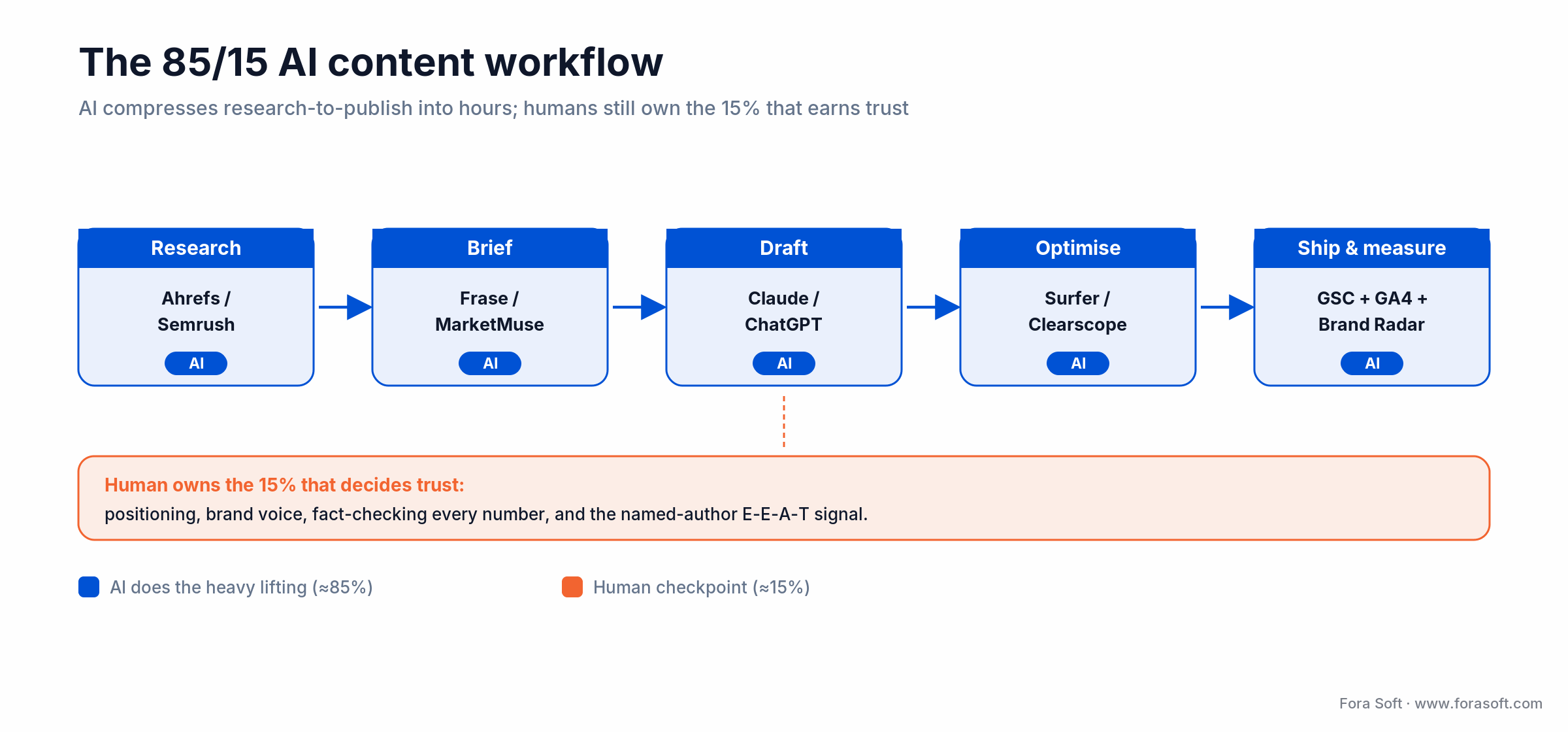
Figure 3. The 85/15 content workflow — AI runs the pipeline, a human owns the 15% that decides trust.
1. The 85/15 content workflow. AI handles about 85% of the work: keyword pull, brief, draft, on-page, schema; a human owns the 15% that decides whether the article earns trust. Concretely: Ahrefs for the keyword, Frase for the brief, Claude for the draft, Surfer for on-page, an editor for voice and facts, Search Console for measurement. This is exactly what we run on the Fora Soft blog, including the article you’re reading.
2. The AEO-first workflow. List the ten questions your best-fit buyer asks in an AI chat. For each, publish a page whose H2 is the question verbatim, whose first two or three sentences answer it cleanly, and which then expands with evidence and internal links. Ship FAQPage and Article schema. Watch citations in Brand Radar or Profound. This is how you own your category inside ChatGPT and Perplexity answers.
3. The AI-assisted technical audit. Crawl the site with Screaming Frog or Sitebulb. Feed the output (indexation, schema errors, internal-link gaps, thin pages) into Claude with a strict prompt: “Rank the five highest-impact fixes by estimated organic lift.” A senior SEO reviews, prioritises and schedules. Most sites recover a surprising amount of dormant traffic this way, and it costs a morning.
AI-assisted keyword research, done properly
Any AI tool will spit out 500 keywords in thirty seconds. Most of it is noise. The job is still strategic: find the intersection of what your buyer types, what your product actually solves, and what you can credibly rank for. Here’s the three-pass filter we use.
- Pass 1 — breadth. Pull seed keywords with Ahrefs or Semrush and cluster by intent: informational, commercial, transactional, navigational.
- Pass 2 — pragmatism. Drop anything where the top-10 Domain Rating dwarfs yours, or where volume is tiny with no commercial upside.
- Pass 3 — the business lens. Paste the shortlist into Claude with your ideal-customer profile and ask which terms a buyer types within 30 days of a purchase. That question usually deletes half the list.
Pass 3 is where AI earns its keep: it applies the commercial judgement your keyword tool can’t. Skip it and you publish beautifully optimised articles for terms no buyer ever converts on.
Generating bulletproof content briefs with AI
A good brief is the single biggest predictor of whether an AI draft needs two edits or twenty. Frase, MarketMuse and Clearscope auto-build briefs from the live SERP; we bolt a short human rubric on top. A production brief includes:
- Target keyword, search intent, and the SERP features to chase (AI Overview, PAA, featured snippet).
- The top three competing URLs with a one-line “what they do better” and “what they miss”.
- The exact question the article must answer in its first paragraph.
- The entities the article must mention, pulled by NLP from the top-ranking pages.
- An internal-link plan: three to five on-site pages to link to, plus one orphan page to rescue.
That last line matters more than it looks. The briefs that consistently rank are the ones that tell the writer where the article sits in your site’s link graph, not just what to say.
Want an AI content engine wired into your product?
We ship LLM-driven writing, summarisation and recommendation features into SaaS products — with SEO, citations and guardrails built in, not bolted on.
Drafting with AI without sounding like everyone else
Default AI prose is plausible and forgettable, and both readers and Google now recognise the smell. Three habits fix it.
1. Ground every draft in your own evidence. Paste two or three real client stories, internal benchmarks or proprietary numbers into the prompt and require the draft to use them. Generic copy turns into first-person expertise the moment it cites something only you know.
2. Give it a brand-voice spec. A 300-word voice guide covering sentence length, tone, banned words and preferred punctuation beats “make it sound more human” every time. Store it as a system prompt and reuse it across articles.
3. Rewrite the top by hand. The intro and first H2 are where AI Overviews and readers form their opinion. Rewrite them yourself; everything below is easier to fix than to replace. We rewrite the first 150 words of every AI draft, no exceptions.
AEO tactics: getting cited in AI Overviews
AI Overviews and answer boxes reward structure over style. The tactics that move the needle are boring and consistent:
- Ask the question as an H2. Exact query match, verbatim — the way your buyer would phrase it.
- Answer in the first one to three sentences. Short, declarative, no throat-clearing before the answer.
- Add specifics and numbers. Answer engines prefer concrete, verifiable statements to hedged prose.
- Ship FAQ, HowTo and Article schema. Validate the JSON-LD with Google’s structured-data docs and rich-results test before deploy.
- Cite authoritative sources. Standards bodies, official docs, major publishers. The AI often borrows your citations — so be the page it borrows from.
GEO tactics: winning inside ChatGPT, Claude and Perplexity
Generative engines pull from a broad source pool and weight recency, authority and clear structure. This isn’t folklore: a Princeton-led study (KDD 2024) tested nine optimisation methods across 10,000 queries and measured which ones actually raise your visibility in AI answers.
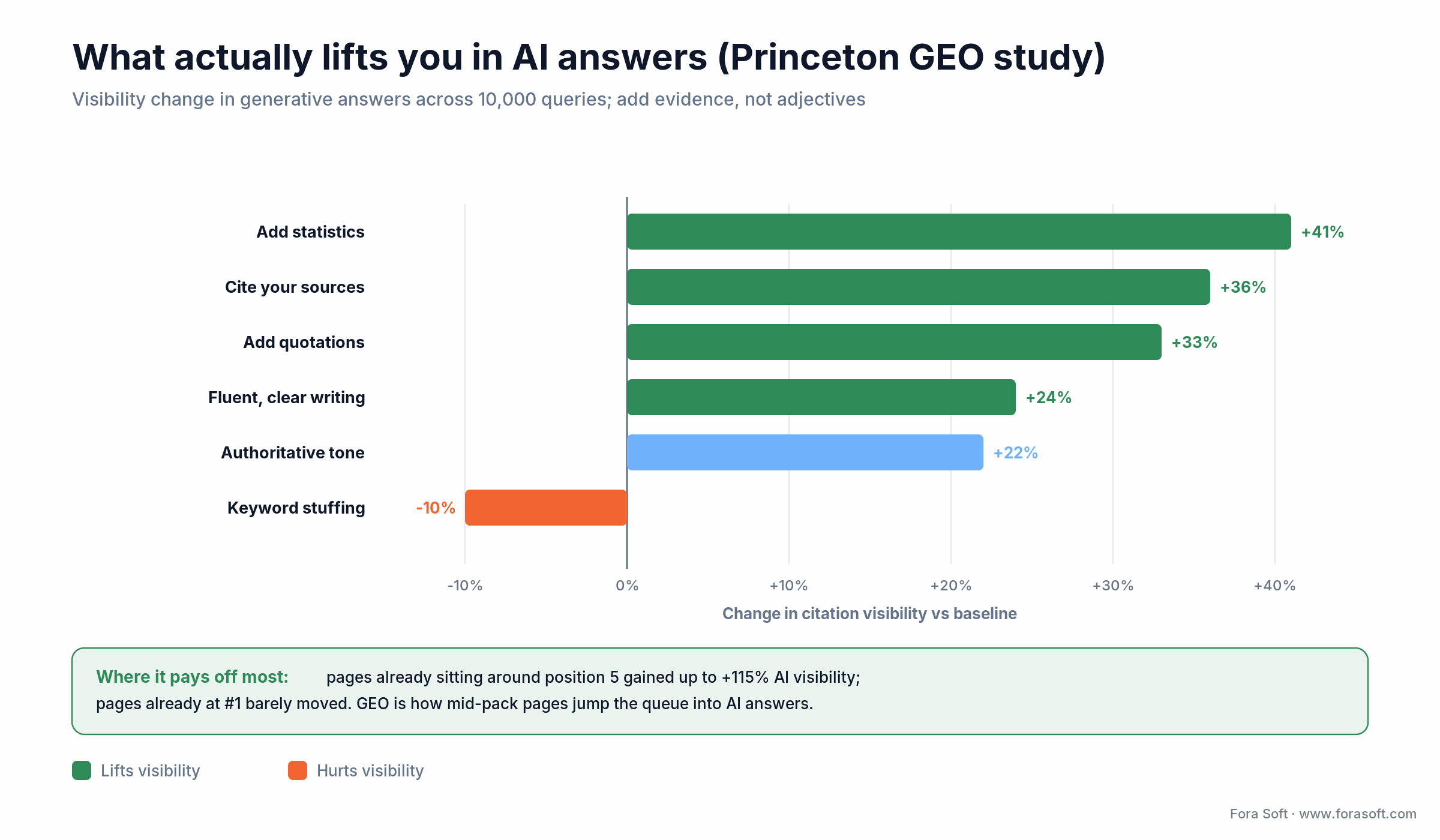
Figure 4. What moved AI-answer visibility in the Princeton GEO study — evidence up, keyword stuffing down.
The winners were unglamorous: adding statistics (+41%), citing sources (+36%) and quoting experts (+33%) drove the biggest visibility gains, while keyword stuffing pushed visibility down. Five moves fall out of that:
1. Lead with evidence. Put a real number, source or quote in the first paragraph of each section. That single habit is what the study rewarded most.
2. Publish and signal recency. Refresh evergreen pages every six to nine months; put the year in the title and a visible “last updated” date in the body.
3. Ship clean structure. Short paragraphs, descriptive H2/H3s, tables for comparisons. Generative engines lift structured information almost verbatim.
4. Earn third-party mentions. Engines trust pages whose domains are referenced by other reputable sources. Digital PR is now a GEO lever, not just a link-building one.
5. Track citations explicitly. Profound, Peec AI and Ahrefs Brand Radar log how often your brand appears in ChatGPT, Claude and Perplexity answers for your target prompts. One nuance worth stealing from the study: mid-pack pages (around position 5) gained the most, up to +115% — GEO is how you jump the queue, not how a #1 defends it.
Reach for GEO tactics when: your buyers research in ChatGPT or Perplexity, you already rank on page one for the topic, and you want the citation instead of the click.
Technical SEO automations that AI makes cheap
Technical SEO is where AI quietly pays for itself. These jobs used to need a senior consultant; now a small team owns them in an afternoon.
1. Internal linking. Export URL, title, H1 and first 200 words. Feed it to Claude: “For each URL, suggest three other pages on this site it should link to, with anchor text.” Review, then ship through your CMS. This is the single fastest ranking win on most established sites.
2. Schema generation. LLMs produce valid JSON-LD for Article, FAQPage, HowTo, Product, Organization and SoftwareApplication in seconds. Always validate before deploy; a model will happily invent a property that doesn’t exist.
3. Alt text at scale. Vision-capable models write contextual alt text for whole image libraries. Give them the page context, not just the image, or you get accurate-but-useless descriptions.
4. Log-file and crawl analysis. Pipe Googlebot logs through Claude or a small agent to classify crawl-budget leaks (parameter explosions, orphaned URLs, soft-404s) and produce a triage list a human can action in an hour.
Measuring AI SEO ROI — beyond clicks
AI Overviews cut click-through on informational queries, but the visitors who do click convert better. That flip means the old “clicks up = winning” scoreboard lies to you. Two things to measure instead: the efficiency of your pipeline, and the quality of the traffic it earns.
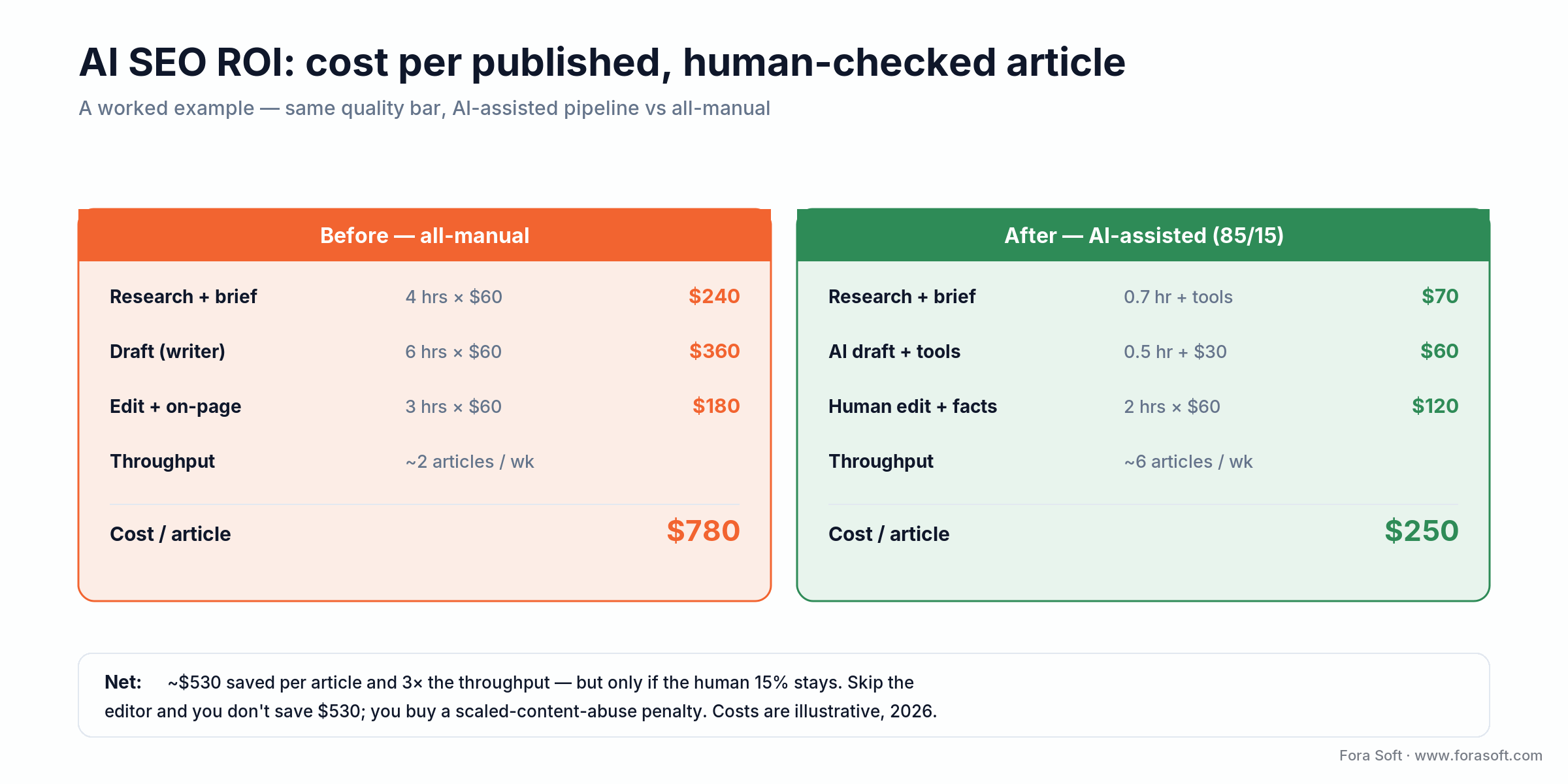
Figure 5. A worked cost-per-article example — the savings are real only while the human 15% survives.
Here’s the arithmetic for a mid-market team publishing weekly. All-manual, research and brief run about 4 hours, drafting 6, editing and on-page 3. Thirteen hours at a $60 blended rate is $780 an article, and you clear maybe two a week. On the 85/15 pipeline: tools plus ~0.7 hour on research and briefing, a $30 AI draft in half an hour, then two hard hours of human editing and fact-checking. That’s about $250 an article and six a week. The delta is ~$530 saved per piece and 3× the throughput — but only while the human 15% survives. Cut the editor and the savings turn into a scaled-content-abuse penalty. The table below is the scoreboard we actually watch.
| Metric | Source | Why it matters | Review cadence |
|---|---|---|---|
| AI citation rate | Brand Radar, Profound, Peec AI | Share of voice in generative answers | Weekly |
| Branded search lift | Search Console | Leading indicator that GEO is working | Monthly |
| Organic conversion rate | GA4 / CRM | Fewer clicks, higher intent | Monthly |
| Assisted pipeline | Multi-touch attribution | Real business impact, not vanity | Quarterly |
| Cost per published asset | Internal tracking | AI-workflow efficiency (see above) | Monthly |
Mini case: what we did on our own blog
Situation. By mid-2024 our blog had 300+ articles, roughly half of them stale, sitting next to stronger recent pieces. Traffic was flat and generative engines almost never cited us. Refreshing everything by hand would have taken a year we didn’t have.
Plan. We built an internal audit pipeline: crawl, then LLM classification (keep / update / merge / redirect), then a senior-editor override on every call. Each “update” article got the same treatment as this one: Minto structure, question-shaped H2s, answer-first paragraphs, FAQ schema, original diagrams, fresh comparison tables, real internal links. AI did the heavy lifting; a human owned every number and every verdict. We wrote about the wider approach in our AI features write-up.
Outcome. Refreshed articles routinely recovered or improved rankings, AI-citation mentions started appearing for target prompts, and refreshed pages converted above the site average, at roughly a third of the per-article cost of the old manual process (about $250 versus $780 a piece, using the math above). The same pattern scales cleanly for clients that publish on a cadence; you can see the writing discipline applied in our AI study guide playbook. Want a similar audit of your library? Grab 30 minutes and we’ll walk your top pages.
Five pitfalls that will tank your AI SEO
1. Scaled AI content. Pumping out dozens of templated pages is the fastest route to Google’s scaled-content-abuse policy (March 2024), which explicitly covers content made by humans, AI, or both. One deep, sourced article beats ten thin ones, and won’t get you manually actioned.
2. Publishing AI text without checking facts. Models invent citations, stats and quotes with total confidence. Every number gets verified; every quote gets a source. This is non-negotiable, and it’s most of the human 15%.
3. Optimising only for Google. If your page doesn’t answer the target question in its first three sentences, AI Overviews skip it and take the prospective visitor with them.
4. Ignoring E-E-A-T. No named author, no case studies, no evidence of real work, and both classic search and generative engines demote you. Put real humans, credentials and projects on every page.
5. Chasing vanity keywords. AI tools surface high-volume, low-intent terms endlessly. If a keyword doesn’t map to a buying decision, it doesn’t deserve an article, no matter how big the volume looks.
A decision framework in five questions
Q1. How many articles do you publish a month? Fewer than two — ChatGPT, Search Console and one optimiser is enough. Ten or more — invest in a full research + brief + optimise stack.
Q2. Are your buyers asking AI directly? If your ICP researches in ChatGPT or Perplexity, AEO and GEO are priority one. If they’re procurement-led with vendor lists, classic SEO and PR matter more.
Q3. Do you have a named subject-matter expert? Without a credentialed human author, your E-E-A-T is fragile and generative engines rarely cite you.
Q4. How fast does your product change? Fast-moving SaaS must refresh content quarterly; stable products can refresh semi-annually.
Q5. Can you run multi-touch attribution? If not, fix that first. Without it, AI SEO looks unprofitable because the assisted pipeline it creates is invisible. That’s exactly the plumbing we build into products — a quick call tells you whether yours can see it.
KPIs worth tracking
1. Quality KPIs. AI-citation rate in ChatGPT, Claude and Perplexity for your top 20 prompts; share of H2 questions answered in the first three sentences; schema-coverage percentage across the library.
2. Business KPIs. Organic-to-MQL conversion rate, assisted pipeline attributed to content, branded-search lift month over month, and cost per published asset (the $250-vs-$780 line above).
3. Reliability KPIs. Editorial cycle time, the percentage of articles with at least one verified source per claim, and the ratio of refreshed to net-new articles shipped each month.
When NOT to lean on AI SEO tools
Three signals say slow down on tooling and put the budget somewhere else.
- You haven’t nailed your positioning. AI amplifies whatever message you have — including a confused one, at speed.
- You have no named experts and can’t hire. E-E-A-T-less content gets buried no matter how well it’s optimised.
- Your product isn’t stable. Ranking for features that ship next quarter creates support debt, not pipeline.
Fix those first. AI SEO tools multiply output; they don’t substitute for judgement, and they can’t rescue a message that isn’t there yet.
Need a sane AI SEO stack for your software company?
We help product-led teams choose tools, set the workflow and ship AI-ready content that both Google and ChatGPT keep citing.
FAQ
Will Google penalise AI-generated content?
Google penalises low-quality and scaled-abuse content, not AI as such. Its March 2024 scaled-content-abuse policy targets mass pages made to game rankings, whether written by a human, a model, or both. An original, sourced, human-reviewed article is fine no matter how it was drafted. Thin, templated, unedited AI content is the target.
What are the best AI SEO tools for a small team?
One research tool (Ahrefs or Semrush), one optimiser (Surfer or NeuronWriter), and ChatGPT or Claude for drafting. That’s roughly $200–$400 a month total and covers everything most teams shipping under 50 articles a year actually need. Add a citation tracker like Brand Radar once AI answers matter to your buyers.
Are there free AI SEO tools worth using?
Yes. Google Search Console (free) is still the most valuable SEO tool you own. Pair it with a ChatGPT or Claude free tier for drafting and NeuronWriter’s entry plan (~$23/mo) for on-page scoring, and you have a credible starter stack for well under $50 a month. Free tools cover the basics; you upgrade when volume or AI-citation tracking demand it.
How do I know if ChatGPT or Perplexity is citing me?
Use a generative-citation tracker — Ahrefs Brand Radar, Profound or Peec AI. They prompt the major engines with your target queries on a schedule and log which domains get cited. Checking this weekly is now standard SEO hygiene, the same way you’d watch rankings.
How long until AI SEO shows measurable ROI?
Directional signals like rankings, branded search and AI citations show in 60–90 days. Revenue attribution usually takes at least six months because B2B buying cycles lag content consumption. If you can’t wait six months, buy ads, not content.
Should I disclose that content was AI-assisted?
Google doesn’t require it. Some brands add an AI-assistance note on a “how we write” page for transparency. What actually moves rankings is quality and E-E-A-T — named authors, verifiable expertise, original evidence — not a disclosure badge.
Can AI replace my SEO agency?
AI replaces the cheaper half of an agency: research, drafts, on-page tweaks. It doesn’t replace senior strategy, brand positioning, high-signal digital PR, or technical judgement calls on complex sites. A good agency uses the same tools you’re considering; you’re paying for the judgement layered on top.
What schema matters most for AI SEO?
Article plus FAQPage plus HowTo for content; Organization plus Person for E-E-A-T; Product plus Offer for commercial pages; SoftwareApplication for SaaS landing pages. Validate everything against Google’s structured-data docs and rich-results test before shipping.
What to read next
AI
How we build AI features into products
The engineering side of the AI we describe here — features, guardrails and where humans stay.
EdTech
AI study guide playbook
Our long-form reference for how we apply AI content discipline inside products.
Estimation
CTO software estimation guide
How to budget for AI-enabled builds, including content and SEO engineering.
AI content
Customisable AI content generation
Techniques for tailored AI output — as relevant to SEO copy as to lessons.
AI
AI mobile app development
How AI-first features ship in production apps — and what that means for your surface area.
Ready to build an AI SEO engine that actually converts?
AI SEO in 2026 isn’t a new channel. It’s a faster operating system for the one you already have: research, briefs, drafts, optimisation, technical fixes and measurement, compressed from weeks into hours. Buy one tool per lane, answer buyer questions in the first three sentences, back every claim with a number or a source, and keep a human on strategy, voice and facts. Do that and the stack below yours quietly falls behind.
If you’re building software and you want your public surface (marketing site, docs, help content, product copy) cited in AI answers as well as ranked in Google, the work starts upstream in how the product and pages are built. That’s the part we do. See how we wire AI into products in our AI integration service, or how we apply the same rigour across our AI-for-video engineering library.
Ready to make AI SEO a pipeline engine?
Send us your site and your target categories. We’ll come back with an honest AI SEO plan — what to build, what to buy, and what to skip.

