

Key takeaways
• The default iOS app architecture in 2026 is MVVM + Coordinators + DI. It is the pattern Apple's own frameworks (SwiftUI, @Observable, Swift Testing) are built around, so you fight the platform less.
• SwiftUI already gives you MVVM for free on simple screens. A View plus @State is a legitimate view-model; add a separate ViewModel when there is real logic to test.
• Coordinators and DI are what make it scale. Navigation lives in its own object; dependencies are injected, so you swap a live network layer for a mock in one line.
• VIPER and TCA are situational, not upgrades. Pick VIPER for 30+ screens and 10+ engineers; pick TCA when deterministic state is the product. Otherwise they cost more than they return.
• The payoff is change cost. On one 42-screen migration, new-engineer ramp dropped from 21 days to 6 and ViewModel coverage went 0 to 84%. That is where the money is.
Why Fora Soft wrote this iOS app architecture playbook
Short version: pick MVVM + Coordinators + Dependency Injection, write it in Swift 6, and let SwiftUI's @Observable do the reactive plumbing where it fits. The rest of this iOS app architecture guide is the reasoning, the code, and the honest edges — including when a different pattern wins.
We have shipped iOS in Swift since the Objective-C days, as part of 250+ projects since 2005, and we were named a TechReviewer Top iOS App Developer in 2024. Along the way we paid the migration tax for every architecture fashion: Massive View Controllers in the Objective-C years, MVP, MVVM with ReactiveCocoa, VIPER, MVVM-C with RxSwift, and now MVVM with Swift Concurrency and SwiftUI. The pattern that survived every generation, and got lighter each time, is MVVM + Coordinators + DI.
One example we can point to: BrainCert, a WebRTC learning platform we built ground-up across web, iOS, and Android. It runs 500M+ real-time classroom minutes at 99.995% uptime, and its iOS client pushes call, chat, and whiteboard state at dozens of updates per second. That kind of app punishes a sloppy architecture within a sprint. This playbook is the exact skeleton we hand a new iOS engineer on day one, updated for Swift 6, iOS 26, and 2026 tooling.
BrainCert's CEO, Yasin Rahim, put it plainly: “From designing the technical architecture to programming, they do it all for us, and I would never even consider using another company.” That standard is what the architecture below is built to hold.
Not sure which architecture your app actually needs?
A 30-minute call with a senior Fora Soft iOS engineer, against your real screen count, team, and roadmap. No pitch, just a straight recommendation.
What actually ships in 2026: the four patterns that matter
The architecture argument has cooled. Apple's frameworks converged on a one-directional data flow that looks like MVVM, and most teams stopped treating architecture as a personality test. Four patterns show up in real new-project decisions, and the table below is how they score against each other.
MVC (Apple's original) is fine for a one-developer utility under ten screens. Past that, view controllers absorb networking, formatting, and navigation, and you get the Massive View Controller that every iOS team has cursed at least once.
MVVM + Coordinators + DI is the production default, and the subject of this guide. SwiftUI's @Observable macro (iOS 17+) made it the lowest-friction way to ship a testable app.
VIPER enforces strict role boundaries and earns its keep in very large teams — think 30+ screens and 10+ iOS engineers where predictable ownership beats speed. For most products it is roughly double the code for a small safety gain.
TCA (The Composable Architecture) from Point-Free is the strongest choice when state must be exactly answerable: trading, multiplayer, complex undo. It has a real learning curve and a strong opinion about testing. Reach for it when reducers-as-state-machines match the product, not by default.
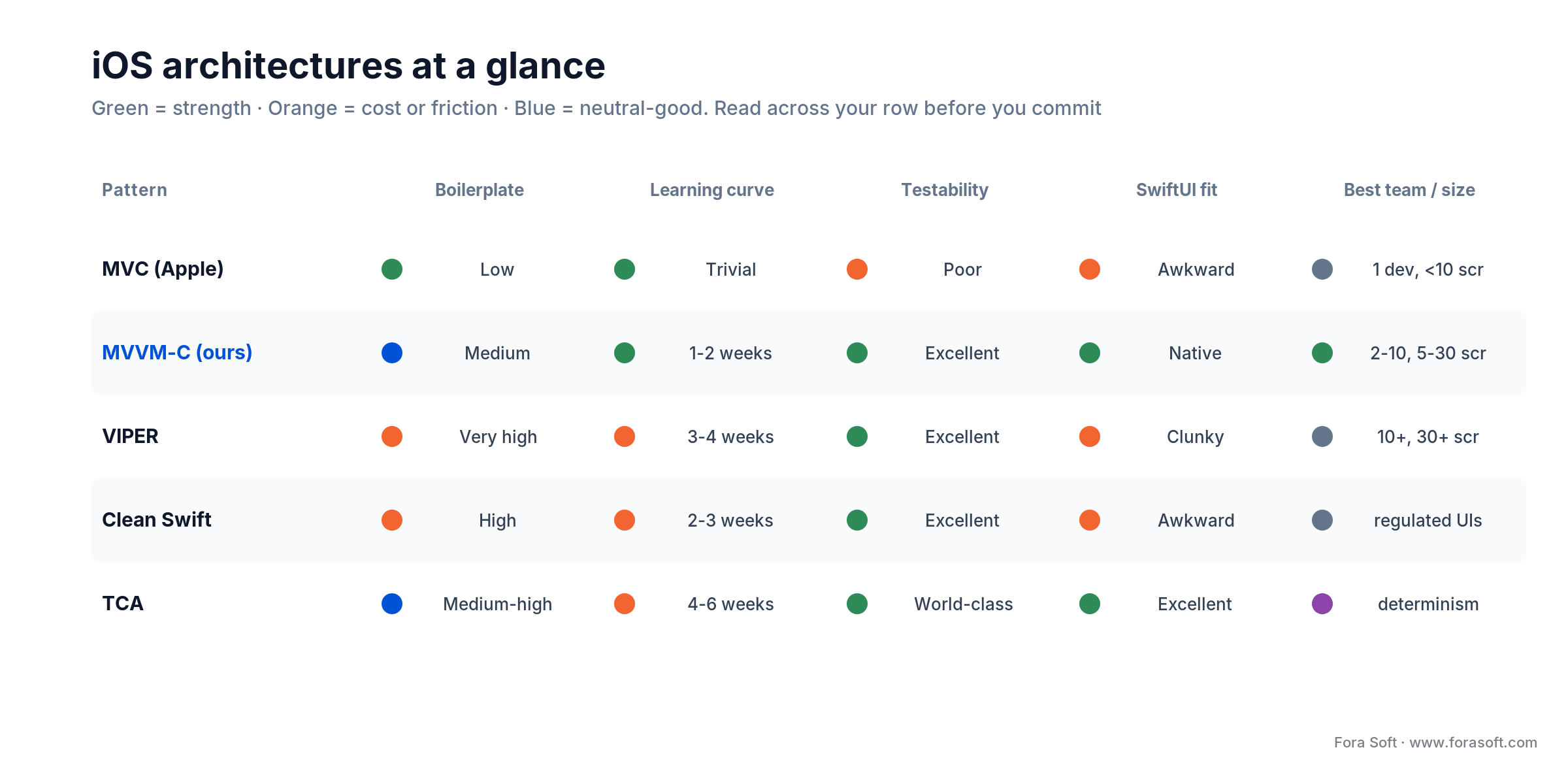
Figure 1. The five patterns at a glance. MVVM-C is the only row with native SwiftUI fit and excellent testability at a medium cost.
Do you even need MVVM in SwiftUI?
Honest answer: not on every screen, and pretending otherwise is how SwiftUI codebases get bloated. This is the one debate most iOS app architecture articles skip, so let's take it head-on.
The skeptics have a point. Apple never says "MVVM" in the SwiftUI docs, and Apple's own sample code injects models straight into views with @Environment and @Bindable, no ViewModel in sight. Thomas Ricouard, who ships the Ice Cubes app, wrote a widely-read "forget MVVM" piece; Azam Sharp argues the SwiftUI View struct already is the view-model. They're right that a View holding @State is, technically, MVVM: the struct is the view-model, SwiftUI does the binding.
Here's where we land after shipping both ways. Wrapping a static list or a settings toggle in a separate ObservableObject is ceremony — skip it, keep the state in the view. Pull logic into a dedicated @Observable ViewModel the moment there is something worth testing without a renderer: a network call, a decision tree, formatting rules, retry logic, analytics. The test is not "is this a screen?" but "is there logic I'd hate to verify through the UI?" If yes, it's a ViewModel. If no, the View is enough.
So MVVM in SwiftUI is not dead; it's just no longer mandatory per screen. That nuance is exactly why Coordinators and DI matter more than the M-V-VM triangle: they are what carry a real app once it grows past a handful of screens.
Reach for a dedicated ViewModel when: the screen has async work, branching logic, or formatting you'd want under test. Keep state in the View for static or purely presentational screens — a separate class there is dead weight.
The MVVM-C anatomy: seven roles, one repeating rhythm
Our production skeleton has seven named roles. Every screen uses the same seven, and that sameness is the point — it's why a new engineer can be productive in days instead of weeks. Figure 2 shows how intent and data move through them.
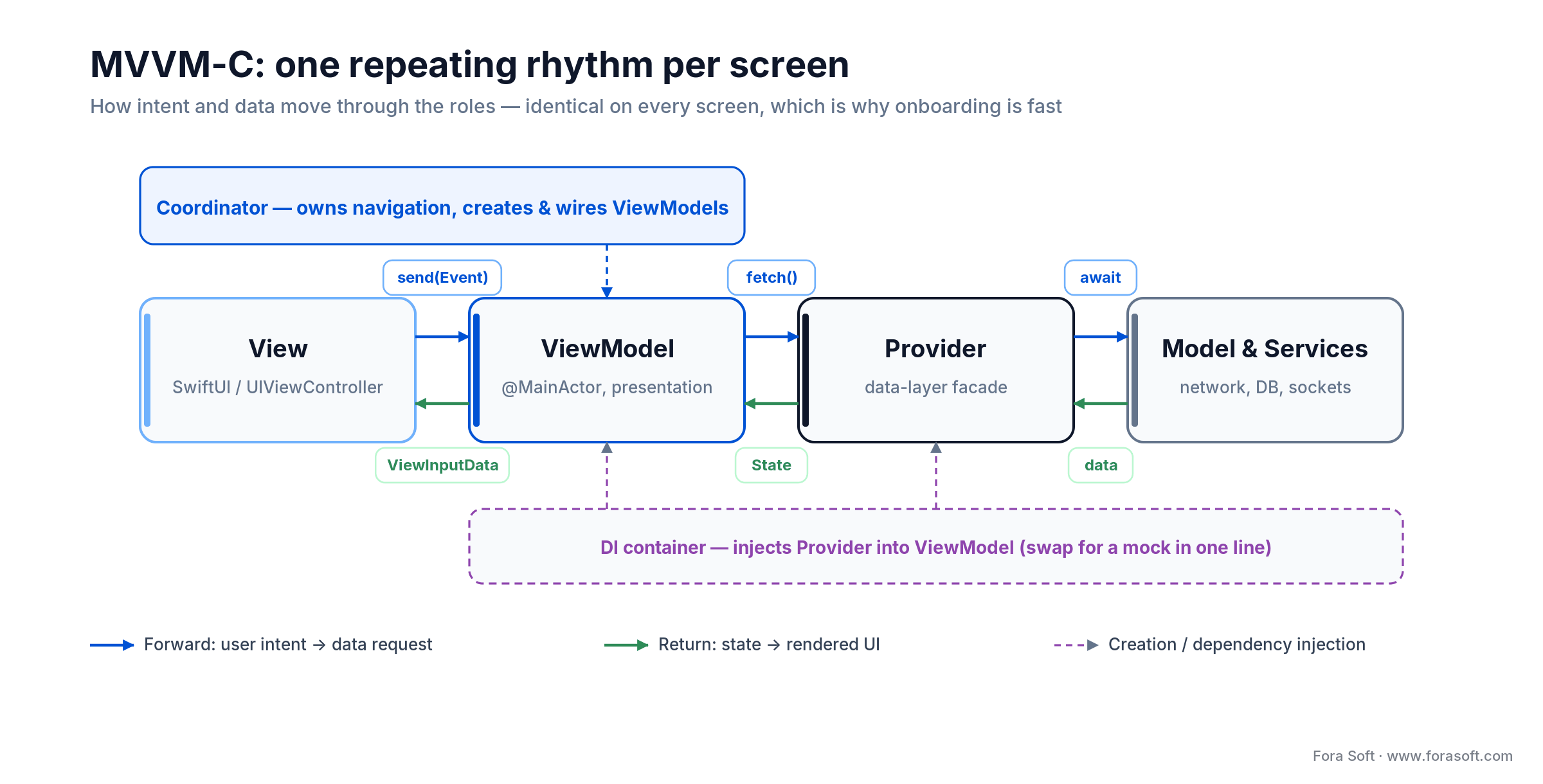
Figure 2. The rhythm every screen repeats: user intent flows right, state flows back, and the Coordinator and DI container do the wiring.
Model. Plain Swift types (struct, actor) that hold domain data. No framework awareness, immutable where you can manage it.
Provider. The data-layer facade for a screen. It talks to services (network, DB, cache) and exposes one observable State. This is what kills the "massive model" smell.
ViewModel. The bridge. It subscribes to the Provider's state, maps it to ViewInputData, receives Events from the View, and owns presentation logic. It never imports UIKit.
View / ViewController. Renders ViewInputData, forwards user actions as Events. Zero business logic.
Coordinator. Owns navigation. It creates ViewModels, attaches handlers like onNoteSelected, and decides which screen comes next.
Router. A thin wrapper around push/pop/present, injected into the Coordinator so coordinators stay testable.
DI container. Declarative registration of Providers, ViewModels, and Views. We use DITranquillity for UIKit-heavy apps and Factory for SwiftUI-first ones.
Reach for the full seven-role setup when: the app has 5+ screens, 2+ engineers, and a 12-month-plus roadmap. For a single-flow tool or a throwaway prototype, plain SwiftUI with @Observable and no Coordinator is the right call.
MVVM in SwiftUI with @Observable
SwiftUI's 2023 Observation framework removed the last excuse to hand-roll reactivity. A ViewModel is a class marked @Observable; the View reads it with @State or @Bindable; updates propagate on their own. No ObservableObject, no @Published, no Combine subscription plumbing.
import Observation

@MainActor @Observable
final class NotesListViewModel {
    private(set) var notes: [Note] = []
    private(set) var isLoading = false
    private let provider: NotesProviding

    init(provider: NotesProviding) { self.provider = provider }

    func load() async {
        isLoading = true
        defer { isLoading = false }
        notes = (try? await provider.fetchAll()) ?? []
    }
}

struct NotesListView: View {
    @State private var viewModel: NotesListViewModel

    init(viewModel: NotesListViewModel) {
        _viewModel = State(wrappedValue: viewModel)
    }

    var body: some View {
        List(viewModel.notes) { NoteRow(note: $0) }
            .overlay { if viewModel.isLoading { ProgressView() } }
            .task { await viewModel.load() }
    }
}
Three things worth noticing. The ViewModel has zero SwiftUI imports, so it tests under Swift Testing without a renderer. The View holds it in @State, not @StateObject — @Observable retires @StateObject. And the Provider is injected, so a test swaps it for a mock in one line.
MVVM in UIKit with Combine: the Fora Soft skeleton
Plenty of production apps still need UIKit for iOS 15/16 support or for control SwiftUI can't match yet. There we keep the Provider → ViewModel → View trio and wire it with Combine (Apple-native) or RxSwift on legacy projects. Here's the compilable core we drop into day-one projects.
import Combine

struct NotesListState { var notes: [Note] = [] }

protocol NotesListProviding {
    var state: AnyPublisher<NotesListState, Never> { get }
    func reload() async
}

final class NotesListProvider: NotesListProviding {
    @Published private(set) var current = NotesListState()
    var state: AnyPublisher<NotesListState, Never> { $current.eraseToAnyPublisher() }
    private let store: NoteStoring
    init(store: NoteStoring) { self.store = store }

    func reload() async {
        let notes = (try? await store.all()) ?? []
        await MainActor.run { current.notes = notes }
    }
}

// ViewModel exposes ViewInputData + Events; the View stays a renderer.
enum NotesListEvent { case viewDidAppear, select(Note.ID), createTapped }
Three rules keep this alive in production. ViewModels never import UIKit, which guarantees they stay testable. Providers own every side effect — networking, persistence, keychain. And Views never touch Providers directly; wiring them is the Coordinator's job.
Reach for UIKit MVVM when: you need iOS 15/16 support, have UIKit components worth preserving, or require UICollectionViewCompositionalLayout performance that SwiftUI lists don't yet match. Mixed apps are normal — wrap SwiftUI screens in UIHostingController.
Coordinators: navigation belongs in its own object
Coordinators fix one specific smell: screens that know about each other. Without them, NotesListViewController imports NoteDetailViewController to push it — fine until the detail screen is reused from search, a deep link, and a share extension, each with slightly different arguments. Now one controller imports five siblings and can't be tested.
Coordinators invert that. The controller only knows "the user tapped a note"; the Coordinator decides what happens next. Three rules from our codebase: one Coordinator per feature flow (not per screen); an AppCoordinator at the root that reads auth state and routes deep links; and coordinators holding strong references to their children so ARC cleans up when a flow ends. That last rule is how MVVM-C avoids the retain-cycle leaks that plagued RxSwift-era MVVM.
final class NotesCoordinator: BaseCoordinator {
    private let router: Router
    private let container: DIContainer

    init(router: Router, container: DIContainer) {
        self.router = router; self.container = container
    }

    override func start() {
        let deps: NotesListDependency = container.resolve()
        deps.viewModel.onNoteSelected = { [weak self] in self?.pushDetail(note: $0) }
        deps.viewModel.onCreateNote  = { [weak self] in self?.pushEditor(mode: .create) }
        router.setRootModule(deps.viewController)
    }

    private func pushDetail(note: Note) {
        let deps: NoteDetailDependency = container.resolve((note: note))
        router.push(deps.viewController, animated: true)
    }
}
Reach for Coordinators when: you have 3+ flows, deep links, modal stacks, or any screen reached from more than one entry point. Skip them for a single linear wizard — the indirection isn't worth it there.
Dependency injection: the contract that makes testing possible
DI is the single highest-return decision in an iOS codebase. Without it you can't unit-test a ViewModel without a live network. With it, you swap the Provider for a mock in one line and test every branch in microseconds. In 2026 we pick one of three libraries depending on the app.
DITranquillity. The workhorse for UIKit-heavy apps. Declarative registration, scopes, and graph validation at runtime via container.makeGraph().checkIsValid(), with near-zero overhead. Our default.
Factory (by Michael Long) — SwiftUI-first and zero-dependency, built on an @Injected property wrapper. The API feels like @Environment, which SwiftUI teams like. It ships as FactoryKit under Swift 6 strict concurrency in 3.x, with an experimental @Dependency macro still in the FactoryMacros companion branch.
Swinject. The oldest option, still widely supported, a touch heavier at runtime. Keep it if you inherit a codebase already on it.
Three lifetime rules save most DI bugs: prototype scope for factories that return a fresh instance each resolve; object-graph scope for dependencies shared within one screen build-up; and singleton scope reserved for genuinely app-wide services like the network client and analytics. Reaching for singletons everywhere quietly re-introduces the global state you were trying to escape.
Inheriting a Swift codebase you don't trust?
We run a fixed-scope architecture assessment: a concrete refactor plan, cost, and risk register, usually inside three business days. You keep the report either way.
Swift 6 concurrency and the actor model
Swift 6's strict concurrency is the biggest architecture shift of the past three years, and Swift 6.2 (2025) softened its sharp edges with approachable-concurrency defaults. async/await replaces completion-handler soup, actor isolates shared mutable state, and @MainActor gives a compile-time guarantee that UI code runs on the main thread.
How it lands in MVVM-C: Providers with shared mutable state (caches, pagination cursors, in-flight tracking) become actor types, so data races turn into compile errors. ViewModels are @MainActor, and await hops off for networking and back on for state updates, retiring the scattered DispatchQueue.main.async calls. And task cancellation is structured, so a running fetch cancels automatically when the user leaves a screen with SwiftUI's .task { }.
Reach for actor-based Providers when: a subsystem has concurrent writers — WebRTC, push-notification sockets, IoT BLE streams, background-audio engines. For read-only or single-caller state, a plain final class is fine.
Testing MVVM-C: Swift Testing and the 80/20 pyramid
The whole reason to pay for this architecture is testability, so here's where the effort goes. We test three layers with three tools, and most of the tests live at the fast base of the pyramid because the logic is injected, not welded to UIKit.
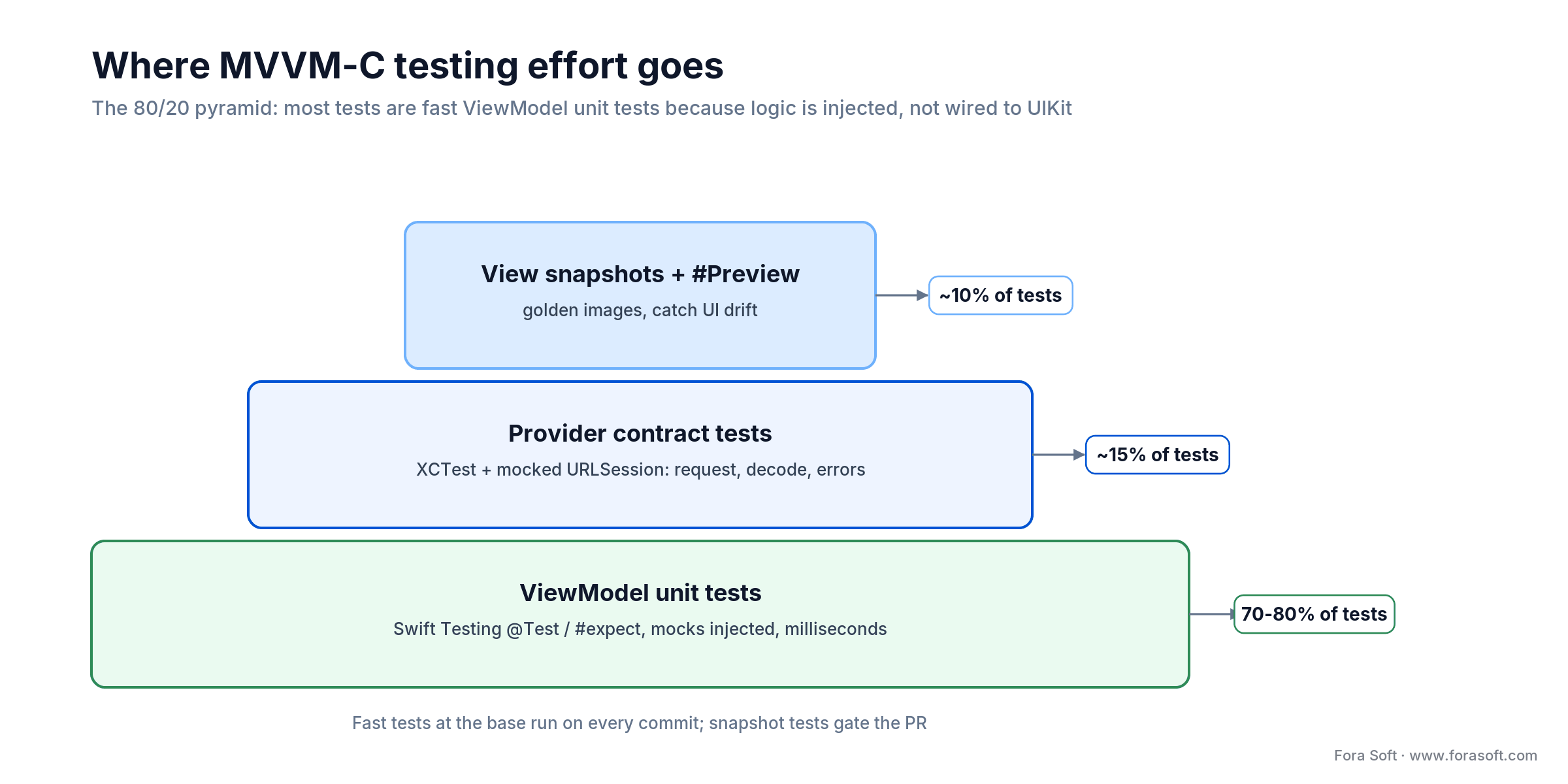
Figure 3. Most tests are fast ViewModel unit tests. Snapshots are few but gate the pull request.
ViewModels under Swift Testing — Apple's framework, GA since Xcode 16 (2024), with @Test functions and #expect(). ViewModels are pure logic over injected Providers; we aim for 80%+ branch coverage here.
Providers under XCTest with a mocked URLSession — contract tests that pin request shape, decoding, and error mapping against real fixtures. Views via snapshot tests (swift-snapshot-testing) and #Preview — we never unit-test Views directly, we snapshot them against golden images.
import Testing

@Suite("NotesListViewModel")
struct NotesListViewModelTests {
    @Test("loads notes on start")
    func loadsOnStart() async {
        let provider = MockNotesProvider(notes: .samples)   // injected in one line
        let sut = NotesListViewModel(provider: provider)
        await sut.load()
        #expect(sut.notes.count == 3)
    }
}
MVVM-C vs VIPER vs TCA vs Clean Swift
The one-line verdict: MVVM-C is the productive middle, VIPER is rigidity you buy for very large teams, TCA is determinism you buy for state-heavy products, and Clean Swift is VIPER's cousin for regulated UIs. The table adds the detail behind Figure 1.
| Pattern | Best fit | Boilerplate | Ramp | SwiftUI fit |
|---|---|---|---|---|
| MVC (Apple) | 1 dev, <10 screens | Low | Trivial | Awkward |
| MVVM-C (ours) | 2–10 devs, 5–30 screens | Medium | 1–2 weeks | Native (@Observable) |
| VIPER | 10+ devs, 30+ screens | Very high | 3–4 weeks | Clunky |
| Clean Swift | Regulated, audited UIs | High | 2–3 weeks | Awkward |
| TCA | Deterministic state machines | Medium-high | 4–6 weeks | Excellent |
A decision framework: pick your architecture in five questions
Work through these top to bottom and stop at the first clear Yes. Figure 4 is the same logic as a tree you can screenshot.
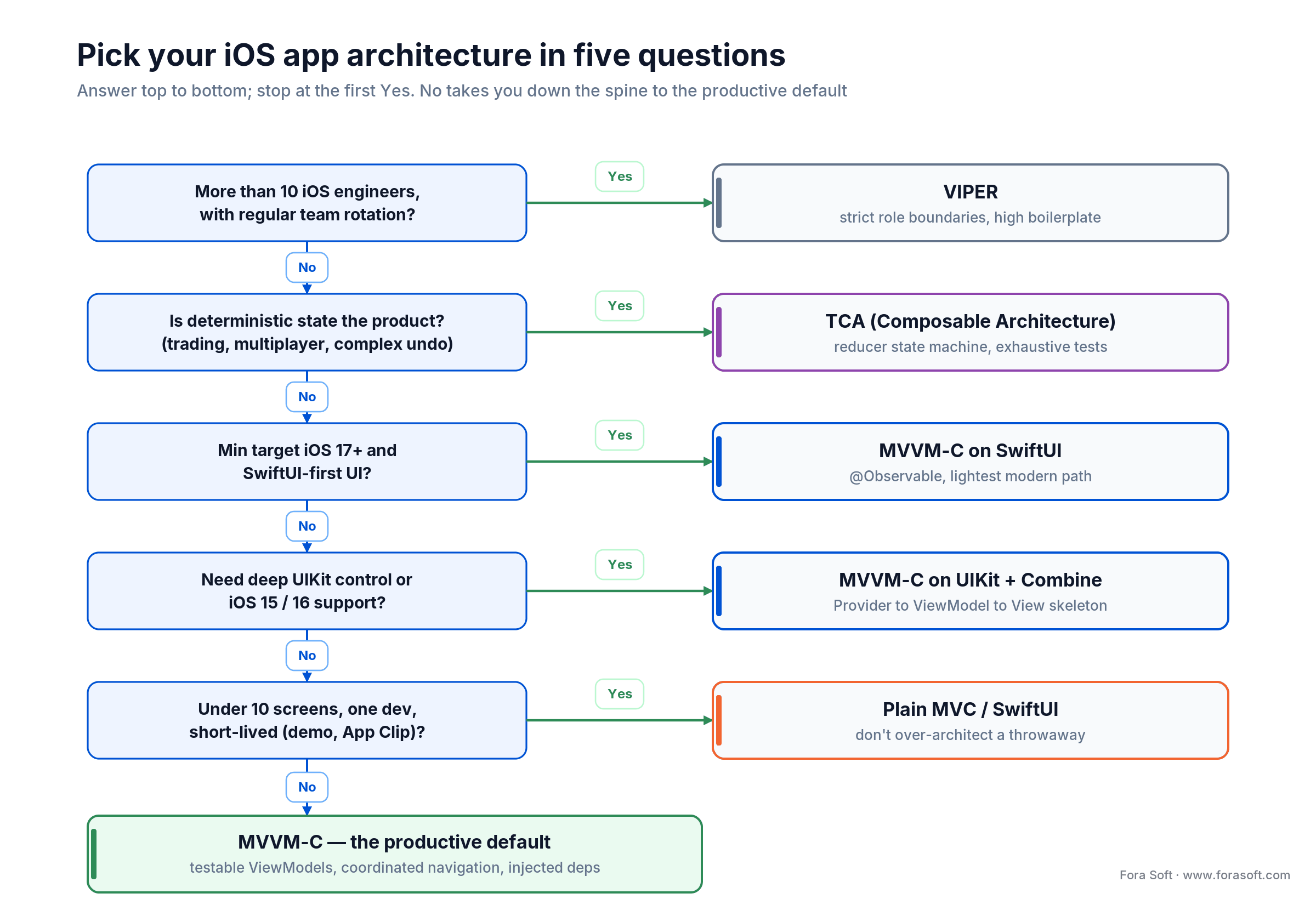
Figure 4. Five questions, one recommendation. Most teams fall to the MVVM-C default at the bottom.
1. More than 10 iOS engineers with rotation? Then VIPER's strict boundaries pay for themselves. Otherwise continue.
2. Is deterministic state the product? Trading, multiplayer, complex undo — anything where "what state am I in?" must be exactly answerable. If yes, TCA. Otherwise continue.
3. Minimum target iOS 17+ and SwiftUI-first? Then MVVM-C on SwiftUI with @Observable is the lightest path. Otherwise continue.
4. Need deep UIKit control or iOS 15/16? Then MVVM-C on UIKit with Combine. Otherwise continue.
5. Under 10 screens, one dev, short-lived? Plain MVC or SwiftUI is fine — don't over-architect a demo. Everyone else lands on MVVM-C.
What MVVM-C costs, and when it pays off
The honest cost is roughly one to two weeks of ramp per engineer, plus maybe 5–8% more code than plain MVVM for the Coordinator and DI scaffolding. On a greenfield app that overhead is near-invisible. The return shows up as change cost, and it compounds with team churn.
Here's the arithmetic we actually use to justify it. Take a team that hires six iOS engineers a year — normal for a growing product with some churn. On a Massive-View-Controller codebase, ramp-to-first-shipped-PR runs about 21 days; on a consistent MVVM-C codebase it's about 6. That's the worked example:
Onboarding saved  = (21 - 6) days  x  6 hires   = 90 engineer-days / year
At a $600/day loaded cost:  90 x $600           = $54,000 / year recovered
Plus: faster feature cycle time, fewer nav bugs (harder to price, real)
That $54,000 is onboarding alone. It ignores the compounding wins — a testable ViewModel layer catches regressions before QA, and coordinated navigation removes a whole class of "wrong screen" bugs. The break-even runs the other way too: below roughly 5 screens or a 12-month lifetime, the DI and Coordinator overhead costs more than it saves. Architecture is a bet on change; if the app won't change, don't place the bet.
Mini case: a UIKit-to-MVVM-C migration that paid for itself
An EdTech video client (anonymized) came to us with a three-year-old UIKit codebase: 42 screens, 8 iOS engineers, a slipping crash-free rate, and a three-week onboarding cost per hire. The audit found the usual root cause — multi-thousand-line view controllers making direct network calls, no ViewModels, and navigation scattered across prepare(for:).
We proposed a 14-week migration to MVVM-C, screen by screen, behind a feature flag. Each sprint we took one vertical feature, extracted its Provider, wrote its ViewModel and tests, added the Coordinator, and cut the view controller down to pure rendering. The old path stayed live until the new one passed QA, so product kept shipping the whole time.
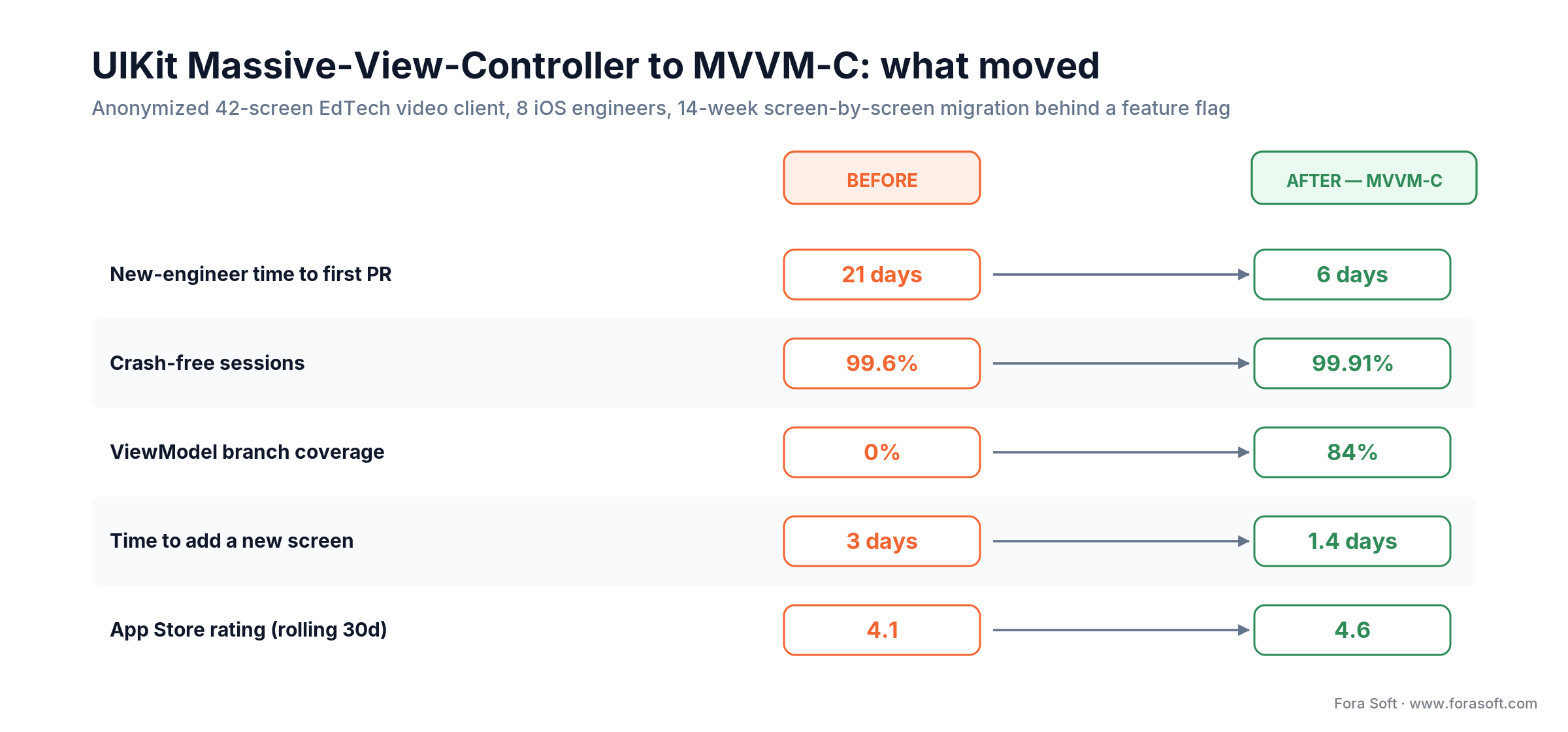
Figure 5. Fourteen weeks, measured. The onboarding and coverage numbers are what funded the next quarter's roadmap.
By week 14: crash-free sessions moved from 99.6% to 99.91%, onboarding from 21 days to 6, ViewModel branch coverage from 0 to 84%, and the App Store rating drifted from 4.1 to 4.6 over the following quarter. Want a similar assessment of your own codebase? Book a 30-minute call and we'll tell you what to refactor first.
The 2026 iOS architecture tooling stack
Swift 6 + current Xcode. Strict concurrency, Swift Testing, mature macros. Non-negotiable for new projects. SwiftLint + SwiftFormat with a shared config, plus a custom rule that bans import UIKit in *ViewModel.swift so the boundary is enforced by CI, not code review.
Tuist or Swift Package Manager for modularization — a five-module split (App, Features, Core, DesignSystem, Networking) cuts incremental build time noticeably on real projects. Periphery catches the orphaned Providers and ViewModels that pile up during refactors. Sourcery or Swift macros generate mocks from a protocol annotation, and swift-snapshot-testing guards the View layer on every PR.
If you're standing up a new build and want a starting point beyond architecture, our Swift 6 iOS development guide covers the migration and concurrency details this section only summarizes.
Real-time, video, and WebRTC: where MVVM-C earns its keep
Real-time clients push state harder than any other product category. A WebRTC call emits track-state, ICE-state, peer-connection-state, media stats, and chat events dozens of times a second. Without isolation that becomes a tangle of delegate callbacks in one controller. With MVVM-C the shape is clean: one actor per signalling channel owning the socket and exposing an AsyncStream of typed events; one Provider per subsystem (call, chat, devices); a ViewModel that composes them into a single ViewInputData; and a Coordinator that owns call lifecycle so nothing leaks when the call ends.
This is the backbone under our video work — we've held it through 90-minute group calls with no memory growth. If you're building video features, our WebRTC in iOS guide and SwiftUI video conferencing playbook go deeper, and the fundamentals in our video engineering Learn hub explain what those state updates actually carry.
Reach for a Coordinator-owned lifecycle when: a flow allocates expensive resources — audio engines, peer connections, camera sessions. The Coordinator creates them on entry and tears them down on exit, so you don't leak an audio engine after a call.
Building real-time or video on iOS?
We've shipped WebRTC clients that survive hour-long calls without leaks. Tell us your latency and scale targets and we'll sketch the architecture with you.
When NOT to use MVVM-C
Architecture is a cost you pay for change, so if the app won't change much, skip it. Three cases where MVVM-C is the wrong answer, stated plainly because honesty here builds more trust than a blanket recommendation.
Throwaway prototypes. A two-week App Clip or trade-show demo doesn't need Coordinators. One SwiftUI App with a couple of @Observable models ships faster.
Single-developer indie apps under 10 screens. The DI container and coordinator plumbing are real overhead. A disciplined SwiftUI-with-MVC codebase by one engineer stays perfectly maintainable.
Apps where determinism is the product. Trading, games, complex regulatory flows — use TCA and enjoy reducer-level tests and time-travel debugging. MVVM-C isn't wrong there, but TCA is stronger, and we'll tell you so.
Five pitfalls that quietly ruin MVVM-C
1. Fat ViewModels. If a ViewModel passes 300 lines, it has quietly absorbed Provider work. Push pure logic into use-cases and keep the ViewModel an orchestrator.
2. View controllers holding Providers. A controller should never import a service directly. If it does, the Coordinator wiring leaked and testability went with it.
3. Coordinator god-object. One AppCoordinator with 20 child-spawning methods is just a Massive Controller wearing a hat. Split by feature flow.
4. Singleton abuse in DI. Registering every service as a singleton silently re-introduces global state. Default to object-graph scope bound to a flow.
5. Ignoring @MainActor. Swift 6 catches most concurrency bugs, but legacy bridges still dispatch to the wrong queue. Annotate ViewModels @MainActor and stop guessing.
KPIs to measure once MVVM-C ships
Engineering KPIs. ViewModel branch coverage (target 80%+), new-engineer time to first shipped PR (target under 7 days), crash-free-session rate (target 99.9%+), and time to add a new screen including tests (target under 1.5 days). If these don't move, the architecture isn't earning its cost.
Product KPIs. Feature cycle time from spec to store before versus after, defect-escape rate from QA to production (target under 5%), and the share of incidents caused by navigation bugs, which should drop toward the floor once the Coordinator owns routing.
Quality KPIs. SwiftLint violations per 1k lines (target under 1), Periphery dead-code findings per release (target zero), and accessibility-audit pass rate — hold it at 100% with the checks in our iOS accessibility playbook.
FAQ
Is MVVM still relevant with SwiftUI's @Observable?
Yes. @Observable (iOS 17+) is MVVM with less boilerplate: the ViewModel is an @Observable class the View reads via @State or @Bindable. It modernized MVVM rather than replacing it. The nuance: add a ViewModel only when a screen has logic worth testing.
What is the best iOS app architecture in 2026?
For most production apps: MVVM + Coordinators + Dependency Injection, in Swift 6, with SwiftUI's @Observable where the deployment target allows. It gives testable ViewModels, decoupled navigation, and easy mocking without the boilerplate of VIPER or the learning curve of TCA.
Does Apple recommend MVVM for SwiftUI?
Apple never names MVVM in the SwiftUI docs, and its sample code injects models straight into views. That's a fair signal that a separate ViewModel is optional on simple screens — a View with @State already is a view-model. Add an explicit ViewModel when there's async work or logic you'd want under test.
When should a team prefer TCA over MVVM-C?
When determinism is a product requirement: multiplayer clients, trading apps, or complex wizards with undo/redo where the exact state must be answerable. TCA's reducer-as-state-machine model and exhaustive testing excel there. For everything else, MVVM-C ships faster with fewer abstractions.
RxSwift, Combine, or Swift Concurrency in 2026?
New code defaults to Swift Concurrency (async/await, actors). Use Combine where you need declarative pipelines or back-pressure, and reach for RxSwift only when you inherit it. Most new screens need async/await plus @Observable and nothing else.
Which DI library should a SwiftUI-first app use?
Factory 3.x is the strongest fit: an @Injected property-wrapper API, zero dependencies, and ergonomics that feel like @Environment. DITranquillity stays excellent for UIKit and mixed codebases.
Do coordinators add too much complexity for small apps?
For fewer than three flows with no deep links, yes — they're overhead. The break-even is roughly five screens, or one screen reused from multiple entry points. Below that, let the View push directly; above it, a Coordinator saves you from a tangle later.
Can we mix UIKit MVVM-C with SwiftUI screens?
Yes, and it's the most common setup in mature 2026 apps. Wrap SwiftUI screens in UIHostingController inside the Coordinator; the ViewModel contract is identical and only the binding syntax changes. New screens in SwiftUI, legacy in UIKit, one shared MVVM-C backbone.
What to read next
iOS
Swift 6 iOS Development
Strict concurrency, migration, and the language changes behind this architecture.
Real-time
SwiftUI Video Conferencing
MVVM-C under load: benchmarks, state, and pitfalls for video on iOS.
WebRTC
WebRTC in iOS Explained
Add real-time audio and video without burning six months on plumbing.
Services
Custom Software Development
Product engineering with a real architecture layer: iOS, Android, backend, ML.
Ready to ship a maintainable iOS app?
Starting fresh in 2026, the answer is MVVM + Coordinators + DI, written in Swift 6, on iOS 17+ where @Observable does most of the reactive work. Drop to UIKit-MVVM-C with Combine for older-OS support or fine-grained control. Reach for VIPER only when team size demands the rigidity, and TCA only when deterministic state is the product. And don't wrap every SwiftUI screen in a ViewModel it doesn't need.
Across every one of those choices, the same three levers — testable ViewModels, coordinated navigation, injected dependencies — are what keep an iOS app cheap to change two years from now. That's the real iOS app architecture decision, and it's the one we help teams get right.
Want a senior iOS team that ships in MVVM-C from day one?
We drop into new and existing Swift codebases, align them to modern MVVM-C, and ship production features inside the first sprint. Thirty minutes, no sales, a straight answer.
.png)
